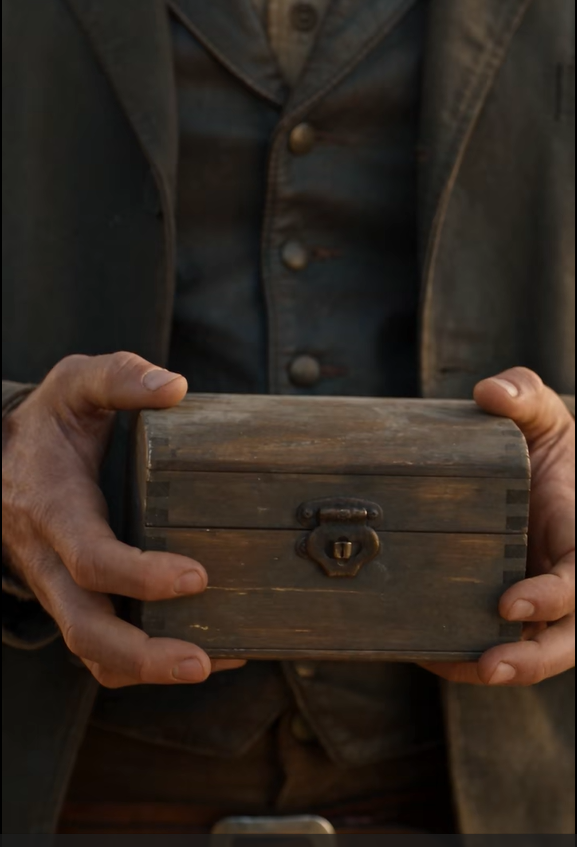
So Ruth hid the deed.
She hid the military records.
She spent the rest of her life preparing a path back to the family she had helped destroy.
Corvin sat motionless.
Sena watched him.
“You loved her.”
“Yes.”
“She did terrible thing.”
“Yes.”
“She loved you.”
Corvin closed his eyes.
“Yes.”
All three things were true.
That was the hardest part.
People wanted monsters to be monsters in every moment.
They wanted good people innocent and bad people empty of love.
But life had never been so mercifully simple.
Ruth Hale Torne had stolen a child from a wounded mother.
Then spent decades loving that child.
Neither truth erased the other.
Corvin folded the letter.
Sena rested one large hand over his.
“What will you do?”
He looked toward the well.
Moonlight reflected from the water.
The same water Ruth had once hidden evidence beside.
The same water Abel had tried to control.
The same water mining men were willing to kill for.
The same water Corvin had given Sena without knowing she was his sister.
Suddenly the whole story of his life seemed to circle that well.
Theft.
Blood.
Secrets.
Return.
Water.
Corvin stood.
He carried Ruth’s confession outside.
For one moment, Sena thought he intended to burn it.
Instead, he placed it inside the first metal cylinder with the military documents.
Then he returned everything to the stone compartment.
“People should know,” he said.
Sena nodded.
“Yes.”
He replaced the stone but did not seal it.
Anyone who truly needed the truth could find it.
At sunrise, Corvin hung a wooden sign beside the well.
He spent nearly an hour deciding what to write.
Not TORNE LAND.
Not APACHE LAND.
Not KEEP OUT.
Four words.
That was all.
When Sena came outside, she read them.
Then looked at her brother.
He smiled.
The sign said:
WATER BELONGS TO THE THIRSTY.
Many years later, travelers still told stories about the morning three hundred warriors surrounded the ranch.
They argued about why no battle happened.
Some said Corvin Torne was brave.
Some said he was lucky.
Some said the mysterious woman spared him because he had shown mercy.
But the people who actually knew what happened understood something far stranger.
Three hundred armed men had not ridden to Red Basin because Corvin gave water to an enemy.
They had ridden there because
a stolen son had unknowingly given water to his own sister.
And with that single ordinary act, he had answered the question his family had carried for thirty-three years.
Had the people who stole him also stolen his heart?
The answer had been waiting beside an old stone well.
No.
They had not.
Because when Corvin Torne saw a dying stranger beneath a merciless sun, he did not ask what blood ran through her veins.
He did not ask who owned the land.
He did not ask which side of a war she belonged to.
He simply gave her water.
And in doing so, he found the road home.