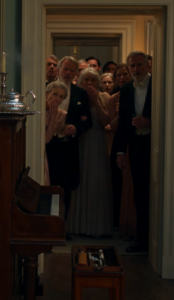
Silas almost laughed.
Not because it was funny.
Because the offer was absurd.
He was filthy.
Starving.
Widowed.
Half barefoot.
He had arrived carrying a sick child and no possessions beyond a knife, a hat, and a blanket.
“You don’t know me.”
“No.”
“I could be a thief.”
“You could.”
“A murderer.”
“Unlikely.”
“How in God’s name do you know that?”
Clara looked at May.
“Because a murderer wouldn’t have walked himself bloody carrying a child.”
Silas had no answer.
Then May made a sound.
Not a word.
A weak, broken moan.
Clara’s face changed instantly.
“We can discuss foolish pride after we keep her alive.”
She stepped toward him.
“Bring her inside.”
Silas hesitated.
Clara snapped, “Mr. Thorne, if you stand there another minute debating whether accepting help insults your manhood, I swear I will hit you with a shovel.”
For the first time in weeks, Silas almost smiled.
He followed her inside.
The house smelled of coffee, cedar, and bread.
Silas had forgotten that homes could smell like anything besides sickness.
Clara prepared a bed in a small room at the end of the hall.
Together, they unfastened the straps.
When Silas tried lifting May from his back, his arms failed.
Clara caught the child.
Silas stumbled against the wall.
“I’m all right.”
“No, you aren’t.”
“My girl—”
“I have her.”
“No.”
Clara froze.
Something wild had entered Silas’s eyes.
He reached for May.
“Give her to me.”
“Silas—”
“Please.”
The word broke.
Clara understood.
She placed May carefully into his arms.
He sat beside the bed and laid her down as though setting fragile glass upon stone.
May’s eyelids fluttered.
“Papa?”
“I’m here.”
“Hot.”
“I know.”
“Want Mama.”
Silas bowed his head.
Clara turned away.
“I know, sweetheart.”
“Is Mama home?”
His throat closed.
He had avoided answering that question for months.
Children did not understand graves.
Sometimes Silas thought adults did not either.
“No,” he whispered. “Not yet.”
May’s eyes closed.
Clara brought cool water.
She mixed willow bark tea and coaxed several spoonfuls between May’s lips.
Then she surprised Silas by producing a small bottle of quinine.
“Where did you get that?”
“Doctor in Rawlins.”
She hesitated.
“I keep medicine.”
“For yourself?”
“No.”
Silas noticed the pause but was too exhausted to question it.
They worked through the afternoon.
By sunset, May’s fever had not broken.
Silas sat beside her, refusing food.
Clara finally shoved a plate into his hands.
“Eat.”
“I’m not hungry.”
“That’s a lie.”
“I can’t—”
“If you collapse, she loses both people caring for her.”
That argument reached him.
He ate.
Beef stew.
Potatoes.
Fresh bread.
The first mouthful nearly hurt.
His body seemed to remember hunger all at once.
He devoured the meal.
Clara pretended not to notice.
Night settled.
May worsened.
At midnight she began shaking.
Silas panicked.
“May!”
Clara rushed in.
The child’s body trembled violently.
Silas grabbed her.
“What do I do?”
“Hold her.”
“She’s freezing.”
“No. The fever’s climbing.”
“Do something!”
“I am!”
Clara soaked cloths in cool water.
May’s eyes rolled beneath her lids.
Silas pressed his forehead against hers.
“Please.”
He did not know whether he spoke to May, Clara, Sarah, or God.
“Please don’t take her too.”
Clara stopped.
She had heard the words.
Her hand covered his.
“Silas.”
“I buried my wife.”
“I know.”
“I can’t bury her.”
“You won’t.”
“You don’t know that.”
Clara looked straight into him.