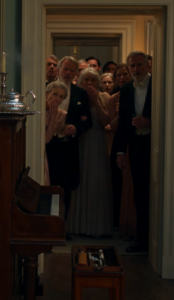
It was upstairs.
Silas had assumed it was storage.
May discovered the door while playing hide-and-seek.
“Miss Clara,” she asked at supper, “why is the little room locked?”
Clara dropped her spoon.
Silas noticed.
“What room?” he asked.
“Upstairs.”
Clara looked sharply at May.
“You shouldn’t be up there.”
May’s face crumpled.
Silas intervened.
“She didn’t know.”
Clara closed her eyes.
“I’m sorry.”
The apology surprised them.
Clara stood.
“That room belonged to someone.”
“Your husband?” Silas asked.
“No.”
“Who?”
She did not answer.
That night, Silas heard crying.
He found Clara sitting on the back steps.
She wiped her face quickly.
“I thought ranch women weren’t allowed to cry.”
“We’re allowed twice a year.”
“Seems inconvenient.”
“I’m saving next year’s.”
He sat beside her.
For several minutes, neither spoke.
Finally Clara said, “I had a sister.”
Silas waited.
“Her name was Eliza. Ten years younger than me. Our mother died having her.”
Clara stared into darkness.
“My father blamed Eliza.”
Silas’s jaw tightened.
“He beat her?”
“Sometimes.”
“And you?”
“I tried stopping him.”
Her mouth trembled.
“When I was sixteen, I left.”
“You left her there?”
The question came harsher than he intended.
Clara flinched.
“Yes.”
Silas immediately regretted it.
“I’m sorry.”
“No. You should ask.”
She folded her hands.
“I told myself I’d come back once I had money. Once I found somewhere safe. But years passed.”
“What happened?”
“When I finally returned, my father was dead.”
“And Eliza?”
“Gone.”
Clara’s voice cracked.
“She had run away at fourteen.”
“Did you search?”
“For twenty years.”
Silas stared.
“Twenty?”
“I hired investigators. Wrote sheriffs. Churches. Orphan homes. Anyone.”
She looked toward May’s bedroom window.
“Nothing.”
Silas understood now.
“You wanted a daughter because you couldn’t save your sister.”
Clara wiped a tear.
“Maybe.”
“You can’t replace her.”
“I know.”
“May isn’t Eliza.”
“I know that too.”
He softened.
“I’m sorry.”
Clara nodded.
Then she whispered something strange.
“So am I.”
Summer faded.
Silas stayed.
His agreement with himself had been simple.
Remain until May recovered.
Then leave.
But May recovered in two weeks.
They were still there two months later.
Because each morning there was another fence.
Another calf.
Another roof board.
Another meal at Clara’s table.
Another evening when May fell asleep against Clara’s shoulder.
Silas began noticing things he had no business noticing.
The way Clara hummed while kneading bread.
The strand of hair that escaped whenever she worked.
The scar along her wrist.
The fact that she never entered church in town though she drove May and Silas there.
The way loneliness sometimes crossed her face when she thought no one watched.
One Sunday, May asked the question they had both avoided.
“Are you going to marry Miss Clara?”
Silas nearly inhaled his coffee.
Clara choked.
“May!”
“What?”
“Children don’t ask things like that.”
May frowned.
“Why?”
Silas tried desperately not to laugh.
“Because grown folks enjoy being miserable and confused.”
Clara kicked him beneath the table.
May smiled.
“So yes?”
“No,” Clara and Silas said together.
May sighed.
“Grown folks are silly.”
She left to feed chickens.
Silas and Clara sat in embarrassed silence.
Finally he said, “She has a point.”
Clara stared at him.
“About us being silly.”
“Careful, Mr. Thorne.”
“Always.”
She rose.
Silas caught her hand.
Clara stopped.
His voice became serious.
“When you offered marriage that first day…”
“You were half dead.”
“I remember.”
“I was desperate.”
“So was I.”