No orchids.
No bridal aisle.
No string quartet.
Just two hundred folding chairs facing a modest stage.
The first Richard and Helen Warren Second Home Initiative residence had opened that morning.
Thirty-six apartments.
A medical clinic.
Legal offices.
A communal kitchen.
A garden.
Housing designed for older adults who had been displaced, financially abused, or told by their families that they had become inconvenient.
Rebecca sat in the front row.
Martin sat beside her.
David sat on the aisle.
I stood backstage holding a folded speech.
“Ready?” Rebecca asked.
“No.”
She smiled.
“Good.”
When my name was announced, the audience stood.
Every person.
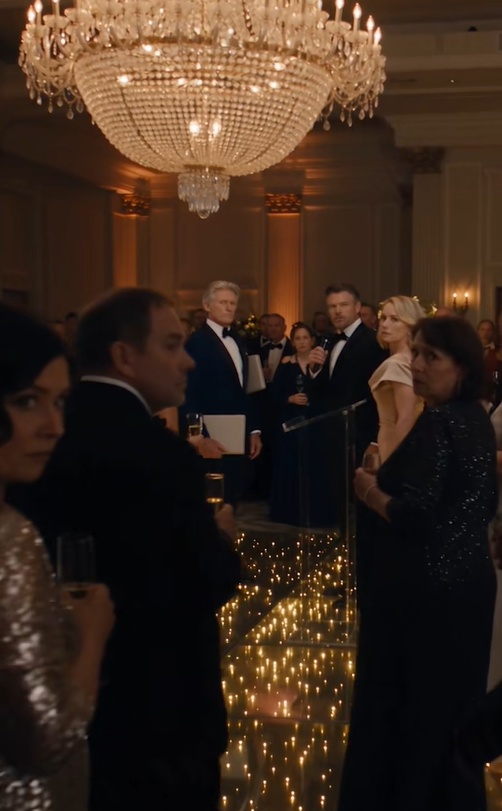
For one strange second, I was back in the wedding ballroom.
The candles.
The whispers.
The pain in my shoulder.
Clara’s voice against my ear.
You’re nobody here.
Then I looked at the faces in front of me.
Widows.
Grandfathers.
Retired teachers.
Former nurses.
People who had raised children, built businesses, survived wars, buried spouses, lost homes, signed bad documents because they trusted family, and discovered too late that age makes some people mistake vulnerability for uselessness.
I stepped to the microphone.
“My name is Helen Warren,” I began.
David smiled from the front row.
“I’m seventy-one years old.”
A few people laughed.
“And one year ago, someone told me I was nobody.”
The room quieted.
I looked toward my son.
He did not look away.
“That person was wrong.”
I unfolded my speech.
Then changed my mind and set it aside.
“So if anyone has ever told you that you are too old, too difficult, too inconvenient, too dependent, or simply in the way, I want you to remember something.”
I paused.
“A person does not become nobody because someone else stops seeing them.”
The applause began before I finished.
It rose beneath the chandeliers.
Louder and louder.
People stood.
David stood with them.
And suddenly I understood the irony.
Clara had moved me behind a marble column because she wanted to erase me from a wedding photograph.
Instead, she had pushed me directly toward the work that would define the rest of my life.
She wanted David to forget his mother.
Instead, she forced both of us to see each other clearly for the first time in years.
She wanted the Bellamy Grand.
She never touched a single share.
She wanted the Warren trust.
It became a refuge for people like the woman she tried to humiliate.
And she wanted me to believe I was powerless because I was old.
That was her greatest mistake.
Power is not always the person standing beneath the chandelier.
Sometimes it is the woman seated behind the column.
The woman nobody notices.
The woman who listens.
The woman who remembers.
The woman who keeps the documents.
And sometimes, when everyone else is finally ready to hear the truth—
she stands.