It offered him details without meaning.
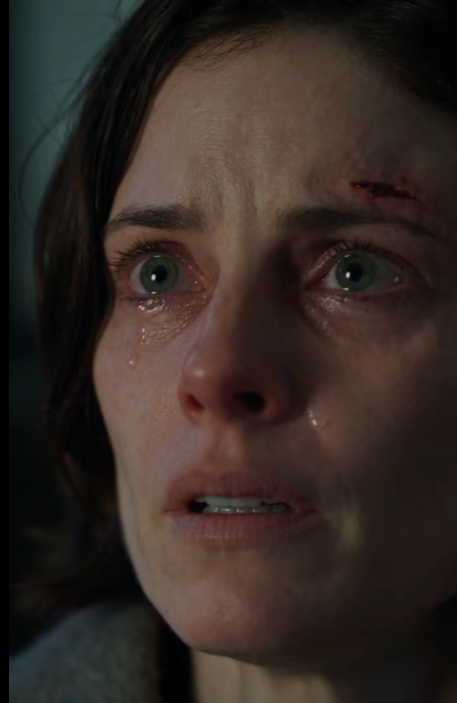
A familiar angle at the eyebrow.
A small hollow beside the mouth.
Eyes older than the ones he remembered, but the same uncertain gray.
“No,” he whispered.
She stopped.
The violin trembled in Elena’s arms.
Maxwell looked at the scarf again.
At the scars.
At the woman’s left hand, which kept smoothing her skirt.
His mother had done that before every performance.
“No.”
This time it was a plea.
The woman raised two fingers to her lips, then held them toward him.
Their old goodnight gesture.
A kiss sent across a room when his father thought he was too old for such things.
Maxwell forgot that anyone else existed.
“Mouse.”
The voice was rough.
Damaged.
Almost unrecognizable.
But the name was not.
He crossed the distance between them and stopped so abruptly that his shoes slid on the marble.
His hands hovered near her shoulders.
For twenty-one years, he had imagined embracing his mother.
Now he was afraid of hurting a stranger.
She solved it for him.
She put her palm against his cheek.
“Oh,” she whispered. “You grew.”
His face broke.
He bent toward her, thirty-five years old and fourteen years old at once, and she caught his head against her shoulder.
“I’m sorry,” he said.
He did not know what he was apologizing for.
Growing.
Believing.
Not finding her.
Isabelle held him as tightly as her thin arms allowed.
“No, darling.”
Her voice scraped.
“No. None of this belongs to you.”
The closed coffin had never held his mother.
Philip had arranged the funeral while Isabelle lay in a private hospital with burns and damaged lungs.
Maxwell listened in a small sitting room off the ballroom, with the door left open at his request.
Eleanor had returned to the conservatory after smoke began pouring into the passage.
She had unlocked it.
By then Isabelle was unconscious.
That act had saved her life.
What came afterward had stolen it.
Philip moved his wife into a private psychiatric facility under a different surname. The records described delusions, self-harm, and a fixation on a child who was supposedly not hers.
When she insisted she was Isabelle Anderson, staff consulted the paperwork that said Isabelle Anderson was dead.
When she asked for Maxwell, they increased supervision.
There had been good people among the staff.
But good people sometimes accepted a file before they listened to a patient.
And Philip paid generously.
“He visited?” Maxwell asked.
His mother looked down.
“Sometimes.”
“What did he say?”
She pressed her lips together.
Then, carefully, “That you knew where I was. That you didn’t want to see me.”
Maxwell rose so abruptly the chair struck the wall.