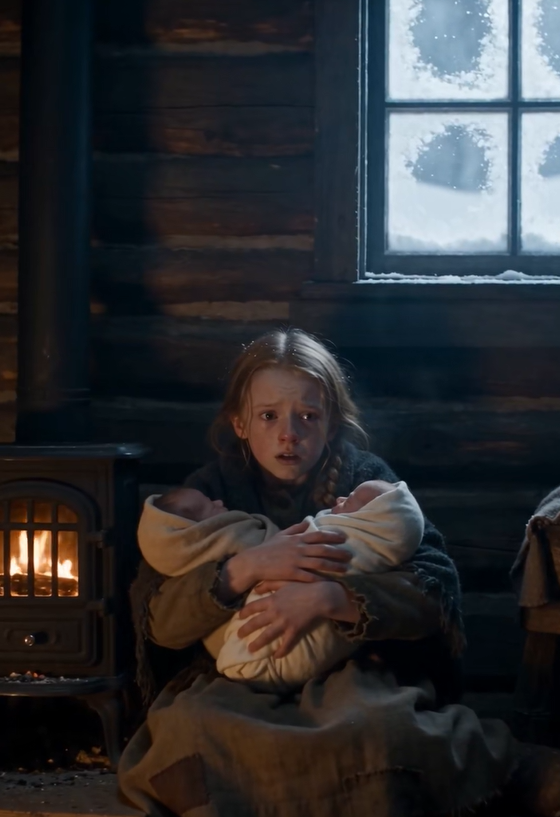
Her eyes went immediately toward the crate beside the hearth.
“Girls?”
Elias nodded.
“Both breathing.”
Her face collapsed with relief.
“Can I…”
She tried to rise.
Pain stopped her.
Elias stood.
He carried the makeshift cradle beside the bed.
Ara touched the nearest baby’s cheek.
Her hand trembled.
“This one is Hope.”
Elias waited.
“And this one?”
Ara looked toward the second child.
Her mouth tightened.
“Grace.”
“They’re good names.”
“They nearly didn’t get them.”
Elias sat in the chair opposite her.
Ara stared at the children.
“My husband didn’t want me naming them.”
“Why?”
Her expression changed.
That was when Elias understood she had been waiting for the question and dreading it at the same time.
“He wanted a son.”
Elias said nothing.
Ara continued.
“Caleb Dorne always said his first child would carry his name.”
Her voice became smaller.
“I thought when they were born he’d change.”
She laughed once.
It wasn’t amusement.
It was disbelief at her own former hope.
“The midwife handed him Hope first. Caleb stared at her like she’d insulted him.”
Elias’s jaw tightened.
Ara’s eyes remained on the child.
“Then the midwife said there was another baby coming.”
She swallowed.
“When Grace was born, he walked outside.”
“What happened afterward?”
Ara looked toward the window.
“For two days he wouldn’t speak to me.”
The fire cracked.
“On the third day he came into the room while the midwife was gone.”
Her fingers closed around the blanket.
“He said I’d embarrassed him.”
Elias felt something dangerous stir inside him.
Ara continued before he could speak.
“He told me every man in town already laughed because he’d married a woman shaped like a broodmare.”
Elias’s eyes hardened.
“He said if I was going to have hips like mine, I could at least have given him a son.”
Ara looked ashamed.
That angered Elias more than the words themselves.
Because the shame belonged to Caleb Dorne, yet somehow he had forced her to carry it.
“What did he do?”
Ara’s voice fell to a whisper.
“He hit me.”
Elias’s hands went still.
“Then he stopped feeding me.”
“What?”
“He said if I wanted enough food for three women, I could find someone willing to pay for it.”
Elias looked toward the babies.
Ara continued.
“Three nights later, he put us in the wagon.”
“Where did he say you were going?”
“He didn’t.”
Her eyes met Elias’s.
“He drove until the road disappeared.”
The rest needed no explanation.
“He pulled me down.”
Elias said nothing.
“He told me no man would ever want a woman like me.”
Her chin trembled.
“And no man would want another man’s useless daughters.”
Elias rose.
Ara flinched.
The movement was almost invisible.
But he saw it.
He immediately stopped.
For a moment, neither spoke.
Then Elias slowly lowered himself back into the chair.
“I’m not him.”
Ara closed her eyes.
“I know.”
“No.”
His voice remained quiet.
“I don’t think you do yet.”
Her eyes reopened.
“But you will.”
Something shifted in the room.
Not trust.
Not yet.
But perhaps the possibility of it.
Ara looked down.
“When I’m strong enough, I’ll leave.”
Elias stared at her.
“I won’t bring him here.”
“You’re not leaving.”
Ara looked up sharply.
“Elias—”
“You’re not walking through winter with two newborn children.”
“I can’t stay forever.”