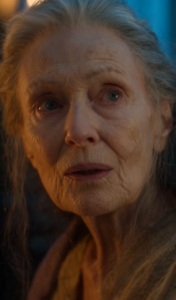
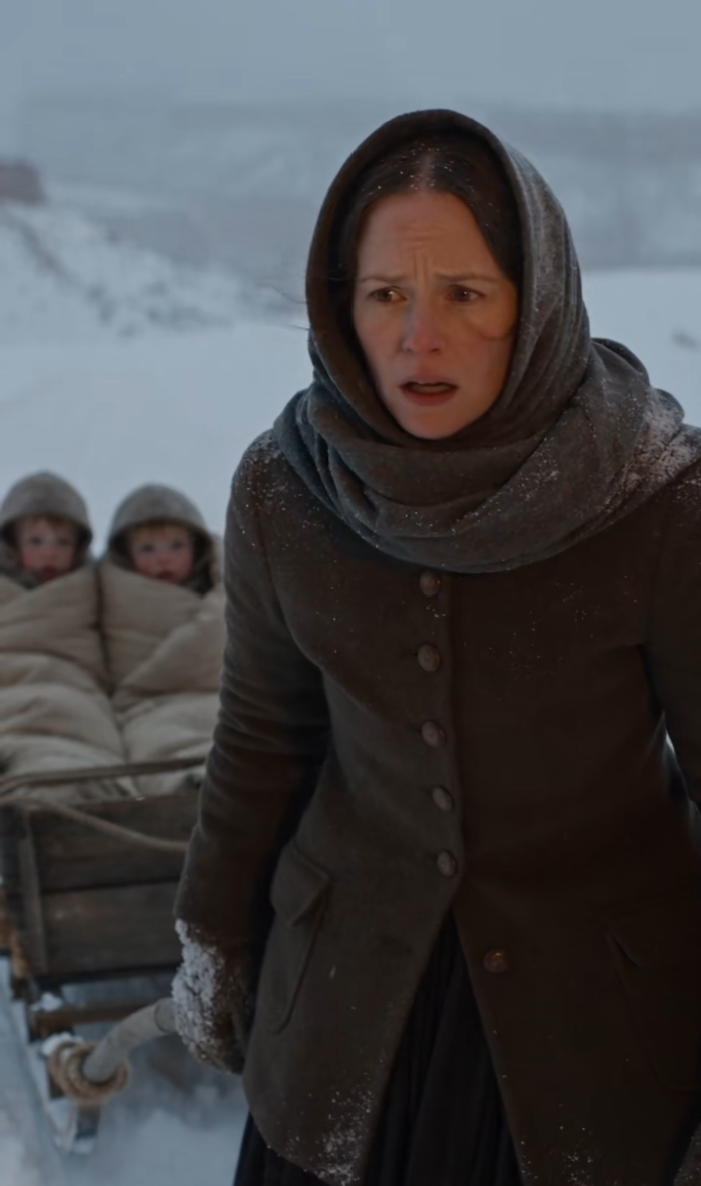
From a leather cord around her neck, she removed something small.
A carved wooden horse.
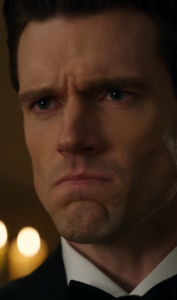
Corvin stopped breathing.
One leg was missing.
The paint had almost entirely worn away.
But he knew it.
He knew the notch across the belly where he’d dropped it against the stone fireplace when he was four.
He knew the crooked ears his father had carved.
He knew because it had belonged to him.
Corvin whispered, “Where did you get that?”
Mara’s eyes filled with tears.
“I made the blanket you slept beneath.”
Corvin stared.
“I sang to you when thunder frightened you.”
His knees weakened.
“You hated goat milk.”
“No.”
“You used to bite my thumb when you were angry.”
“Stop.”
“Your first word was not ‘Papa,’ though Elias always told you it was.”
“Stop.”
“Your first word was ‘water.'”
Corvin backed away.
Mara’s voice broke.
“I am your mother.”
The world disappeared.
The riders.
The guns.
Rusk.
The ranch.
Everything.
Only those four words remained.
Corvin shook his head.
“My mother died.”
“No.”
“She died when I was a baby.”
“No.”
“My father told me—”
“Your father believed I was dead.”
Corvin could barely form words.
“You are Apache.”
“Yes.”
“My mother was Miriam Torne.”
Mara reached into the satchel.
She removed a faded photograph.
Corvin had seen a copy of it all his life.
A young Elias Torne standing beside a seated woman in a dark dress.
Corvin had always assumed her light complexion in the washed-out photograph meant she was white.
Now Mara held the photograph beside her face.
The same eyes.
The same broad cheekbones.
The same slight bend at the left corner of the mouth.
“Miriam was the name recorded by the missionary who taught me English,” she said. “Elias called me Mara because he could pronounce it more easily.”
Corvin stared at her.
He saw it.
Once he saw it, he could not stop seeing it.
His own eyes.
His father’s nose.
Her height in his shoulders.
Her hands in his.
“No.”
It came out weakly.
Mara stepped toward him.
He stepped back.
That hurt her.
He saw it.
But he could not stop.
“Why did you leave me?”
“I didn’t.”
“You were alive.”
“I thought you were dead.”
Corvin froze.
Mara wiped one tear angrily from her cheek.
“When you were seven, Rusk’s men came at night.”
Corvin remembered fire.
He had always remembered fire.
His father dragging him onto a horse.
Shots behind them.
A barn burning.
He had been told rustlers attacked the ranch.
Mara continued.
“Elias hid you with a family in Dry Creek. I was north with relatives. Gideon knew Elias had discovered what he was doing with land deeds and water claims. He attacked our camp too.”
Her voice grew quieter.
“I was shot.”
Corvin looked at the scar along her temple.
“They told Elias I died. They told me Elias and my son died in the ranch fire.”
Corvin’s breath shook.
“Who told you?”
Mara looked at Gideon.
Corvin followed her gaze.
Gideon Rusk’s smile had disappeared.
Mara said, “One of his men.”
Corvin’s entire body went cold.
“You separated us.”
Rusk shrugged.
“It was business.”
Mara flinched.
Corvin did not.
Something beyond rage had taken hold of him.
A terrible clarity.
“Twenty-three years.”
Rusk replied, “Your father should have sold.”
Corvin stepped forward.
Mara caught his arm again.
This time he tried to pull free.
She held him.
“Let me go.”
“No.”
“He stole twenty-three years.”
“Yes.”
“He killed my father.”
“His son did.”
“I don’t care which one I shoot first.”
Mara turned Corvin toward her.
Her face was inches from his.
“Then listen to the mother you just found.”
Corvin stared at her.
She spoke slowly.
“If you kill him in anger, he takes one more thing from this family.”