“The man who stopped my father’s letters.”
He turned another page.
“‘Payment for information regarding survival of Miriam Torne.'”
Mara went completely still.
Corvin looked at Gideon.
“You knew she lived.”
Rusk stared back.
“You knew we both lived.”
Silence.
“You could have ended this twenty years ago.”
Rusk gave a tired smile.
“And lose the valley?”
Corvin almost struck him.
Almost.
Instead he closed the ledger.
“No.”
Rusk’s smile faded.
“You don’t get my anger.”
By late afternoon, riders appeared from Dry Creek.
Not Rusk’s men.
Settlers.
The battle had been heard for miles.
Among them came Sheriff Amos Bell, two territorial deputies, and nearly thirty townspeople who had spent years fearing precisely the sight now surrounding Corvin’s ranch.
Hundreds of Apache warriors.
Weapons.
Smoke.
Bodies.
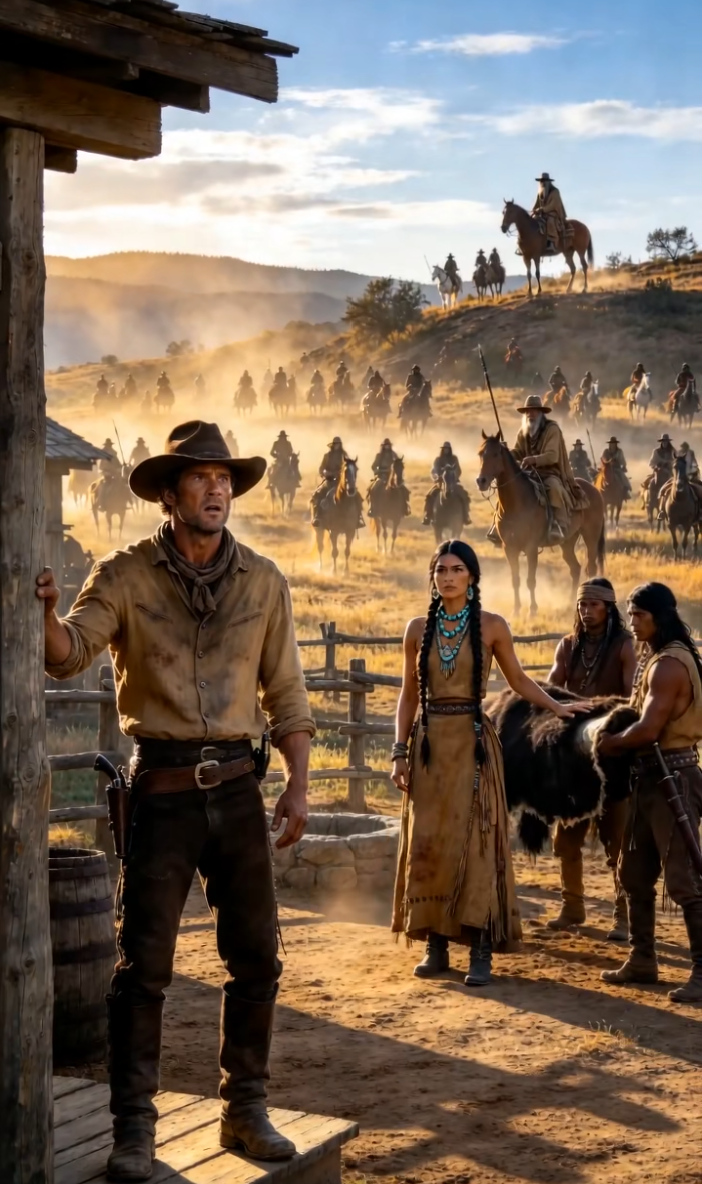
For one dangerous minute, everyone reached for guns again.
Then Corvin walked between them.
Alone.
His shoulder bandaged.
His father’s bloodstained journal in one hand.
Rusk’s ledger in the other.
“Nobody fires.”
Sheriff Bell stared at him.
“Corvin, move.”
“No.”
“Those hills are covered with—”
“I know who’s on the hills.”
“Then move.”
Corvin looked at the townspeople.
Faces he knew.
Men who had helped raise barns.
Women who had brought food after his father’s disappearance.
People who had repeated the same story for decades.
Apache killers.
Apache raiders.
Apache thieves.
Corvin lifted the ledger.
“Gideon Rusk poisoned Willow Wash.”
Murmurs.
“He paid men to attack ranches.”
More murmurs.
“He bought land from families after he frightened them away.”
Sheriff Bell stared at Gideon, now tied beside the barn.
Rusk shouted, “He’s lying!”
Corvin tossed the ledger to Bell.
“Read.”
The sheriff did.
His face changed.
Page after page.
Then Corvin showed him Elias’s journal.
Finally, he pointed toward the coffin.
“That’s my father.”
Bell removed his hat.
Corvin swallowed.
“He wasn’t killed twenty-three years ago.”
The crowd fell silent.
“He spent those years collecting evidence against Rusk.”
A woman whispered, “Where?”
Corvin looked toward Mara.
“With my mother’s people.”
Bell frowned.
“Your mother?”
Corvin hesitated.
Twenty-three years of certainty pressed against one sentence.
Then he said it.
“Mara is my mother.”
The confession moved through the crowd like wind through grass.
Mara did not look at them.
She looked only at Corvin.
For the first time since sunrise, Corvin realized the warriors on the ridges were not there merely to defend her.
They were waiting to see whether he would deny her.
He didn’t.
He walked to Mara.
Then stood beside her.
Not in front.
Not behind.
Beside.
Gideon Rusk laughed from the barn.
“You think that makes you noble?”
Corvin turned.
“No.”
“You think they’ll accept you now?”
“I don’t know.”
“They won’t.”
“Maybe.”
“Then what have you gained?”
Corvin looked at Mara.
“A mother.”
Rusk’s face twisted.
“After twenty-three years?”
Corvin’s answer came quietly.
“Twenty-three years late is still better than never.”
Mara lowered her head.
Her shoulders shook once.
Corvin pretended not to notice until she regained control.
Sheriff Bell closed the ledger.
“Gideon Rusk, I’m placing you and your son under arrest.”
Rusk stared.
“For what?”
Bell looked at the dead men, the poison barrels, the documents.
“We can start with murder.”
Rusk spat at the ground.
Then smiled.
“You all still have a problem.”
Corvin frowned.
Rusk nodded toward the well.
“That land is mine.”
“No, it isn’t.”
“It will be.”
He looked toward the townspeople.
“Torne owes the bank.”
Corvin’s heart sank.
That was true.
Two bad cattle years had nearly ruined him.
Rusk knew it.
“The note comes due next month,” Rusk continued. “And who owns the bank’s largest share?”
Nobody answered.
Rusk smiled.
“I do.”
Sheriff Bell cursed softly.
Rusk laughed.
“Arrest me if you like. A company doesn’t go to jail. When the note defaults, the ranch transfers. The well becomes company property.”