Perhaps they assumed I would retreat.
Then Maxwell did something I would later understand he regretted almost immediately.
He lifted the violin from its case.
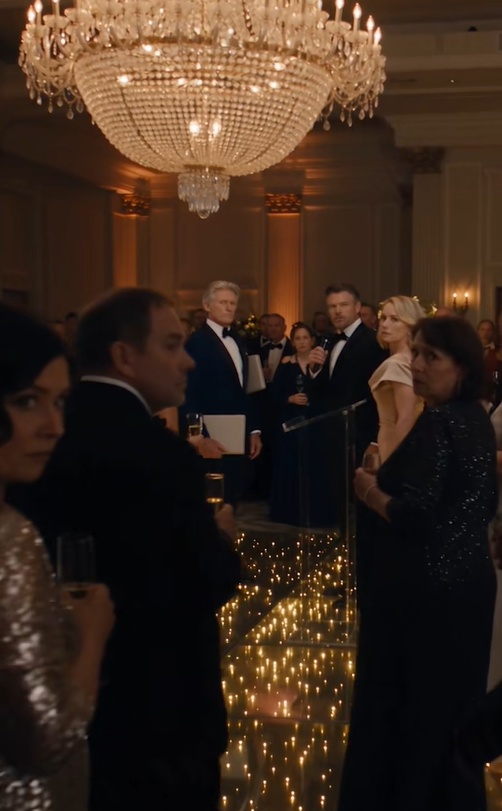
There was already champagne in his system, grief in his eyes, and an audience around him.
“Then play.”
Vanessa laughed.
“Oh, Max.”
He held the violin toward me.
“Come on. One song.”
I didn’t move.
“Unless,” he said, attempting a smile, “you were exaggerating.”
More laughter.
Something old and angry awakened inside me.
I set my tray down.
Then I untied my white apron.
I folded it once.
Twice.
Placed it over a chair.
And stepped forward.
Vanessa watched me with open amusement.
Maxwell offered me Isabella.
Our fingers touched.
His smile faded slightly.
Maybe something about the way I held the violin disturbed him.
Maybe memory had already begun moving behind his eyes.
I raised it beneath my chin.
Vanessa lifted her glass.
“If she can actually play,” she announced, “we should give her a raise.”
Laughter.
Maxwell looked at me.
Then, perhaps because wealthy men sometimes confuse humiliation with charm, he said:
“If you can play this, I’ll marry you right here, right now.”
The ballroom erupted.
Vanessa laughed louder than anyone.
I looked into Maxwell’s eyes.
“No,” I said quietly. “You won’t.”
Then I placed the bow against the strings.
The Harbor Lullaby had never been published.
Eleanor wrote it when Maxwell was seven.
He had become terrified of storms after lightning struck a tree outside his bedroom and sent burning branches through the nursery windows.
For months afterward, thunder made him panic.
Doctors were called.
Therapists visited.
Nothing helped.
Then Eleanor began playing.
Fourteen measures.
Simple enough for a child.
Beautiful enough to break a heart.
She told Maxwell the melody represented a little boat finding its harbor after a storm.
Only three people knew every note.
Eleanor.
Maxwell.
And me.
When I reached the eighth measure, Maxwell whispered my name.
“Elena.”
I finished anyway.
Then he asked the question I had imagined hearing for twelve years.
“How do you know my mother’s song?”
I lowered the violin.
Before I could answer, Vanessa’s glass shattered.
For a moment, nobody moved.
Then Margaret Caldwell stepped forward.
“Enough.”
Her face had changed.
Most people were watching Maxwell.
I was watching Margaret.
Because Margaret Caldwell knew exactly who I was.
“Give me the violin,” she said.
I held it tighter.
Maxwell looked between us.
“You know her?”
Margaret recovered quickly.
“Of course not.”
“You looked at her as if—”
“This is your wedding day,” Vanessa interrupted. “Why are we interrogating staff?”
Maxwell ignored her.
“Elena.”
His voice was quieter now.
“How do you know that song?”
I looked at him.
“Your mother taught me.”
A murmur traveled across the ballroom.
Maxwell stared at me.
“When?”
“When we were children.”
His face changed again.
“You knew my mother?”
“Yes.”
“How?”
I swallowed.
Because there are truths people spend years preparing to speak, only to discover that when the moment arrives, the words still hurt.
“She saved my life.”
I was eleven when Eleanor Anderson found me sleeping in the laundry room of St. Catherine’s School for Girls.