I understood.
Thomas Marlowe was Maxwell’s biological father.
Richard Anderson was mine.
We had believed for a year that we shared a father.
We didn’t.
We were not brother and sister at all.
The room went dead quiet.
Then Maxwell slowly looked toward Isabella.
Then toward me.
And, despite everything, I knew exactly what he was remembering.
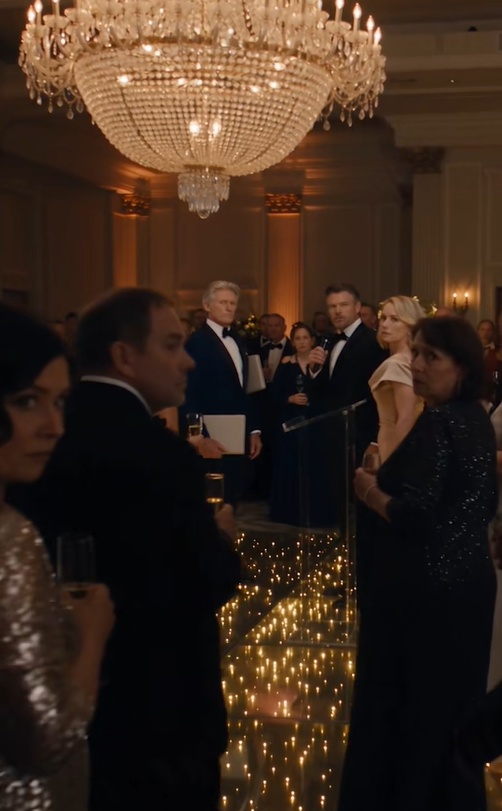
The ballroom.
The laughter.
His ridiculous challenge.
If you can play this, I’ll marry you right here, right now.
I pointed the bow at him.
“Don’t.”
His mouth twitched.
“I didn’t say anything.”
“You were about to.”
“I absolutely was.”
“Maxwell.”
The children had no idea why the adults were beginning to laugh.
Neither did the donors.
Rebecca stared at us in confusion.
Maxwell finally lost the battle.
He laughed so hard he had to sit on the edge of the stage.
I started laughing too.
After everything—stolen money, hidden letters, false fathers, lost childhoods, a ruined wedding, a secret room, and two completely different family trees—the universe had apparently decided we deserved one absurd joke.
When the laughter faded, Maxwell looked at me.
Really looked at me.
Then he said quietly, “You know something?”
“What?”
“You’re still my sister.”
My eyes burned.
I smiled.
“And you’re still an idiot.”
He nodded.
“Fair.”
Rebecca began crying.
I took Maxwell’s hand.
Because blood had already lied to us enough.
Names had lied.
Money had lied.
Family records had lied.
But there was one thing Eleanor had understood long before either of us.
Family was never hidden in a birth certificate.
It was hidden in who stayed during the storm.
Who searched when you disappeared.
Who believed you when everyone else laughed.
Who remembered the melody.
I raised Eleanor’s violin again.
Outside the Anderson estate, rain began falling over Newport.
A low roll of thunder moved across the Atlantic.
Several children looked nervously toward the windows.
I smiled.
Then I played the song Eleanor had written for a frightened little boy decades earlier.
The Harbor Lullaby.
Maxwell sat beside the piano.
Rebecca closed her eyes.
And beneath Eleanor’s portrait, surrounded by children who had been told in a hundred different ways that they were unwanted, I finally understood why Eleanor had trusted music with the truth.
Documents could be stolen.
Letters could be hidden.
Money could buy silence.
Names could be changed.
But a melody remembered by someone who loved you could survive everything.
I played the final measure.
Four quiet notes.
The same four Eleanor had played during every childhood storm.
This time, when the room fell silent, nobody was laughing.
And for the first time in my life, silence didn’t feel like being invisible.
It felt like being heard.