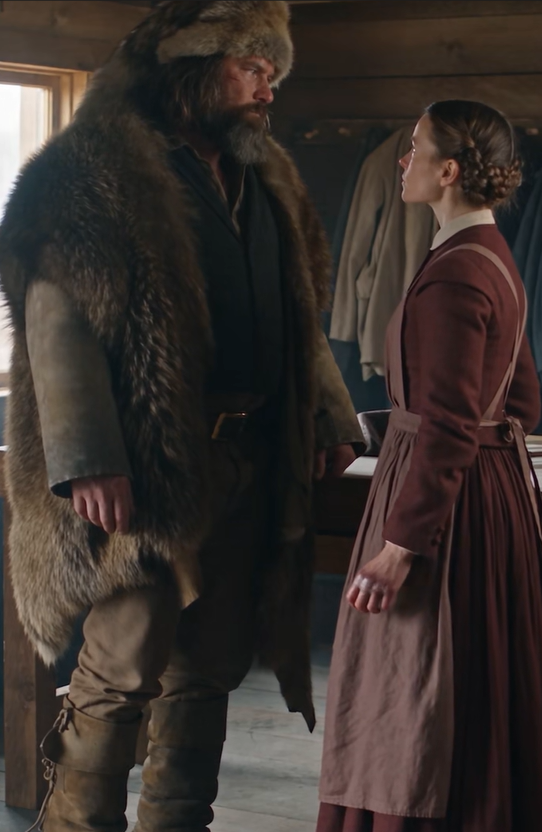
For once, the mountain man had no answer.
So Lydia kissed him.
Not because a marriage certificate demanded it.
Not because a husband expected it.
Not because fear told her she must.
Because she chose to.
Gideon’s hand touched her cheek and stopped there.
Waiting.
Lydia smiled against his mouth.
“You can keep going.”
His eyes softened.
“Does it hurt?”
The question struck something deep inside her.
Months earlier, those words had filled the cabin with terror.
Now Lydia understood how much a life could change when one person cared about the answer.
“No.”
She took his hand.
“Not anymore.”
They never sold the land at Black Elk Pass.
The railway company offered Gideon enough money to make him wealthy.
He refused.
Instead, Lydia negotiated.
The company received a narrow right-of-way.
Gideon kept the timber.
The town received a station.
And one clause Lydia insisted upon caused three railroad attorneys nearly to choke during negotiations.
A percentage of every freight fee through Black Elk Pass would fund a women’s lodging house beside the station.
They called it Ellen House.
Women arriving alone could stay free for thirty days.
No marriage agent could enter without invitation.
No employer could remove a woman without her consent.
The house maintained employment listings, legal contacts, railway schedules, and locked rooms.
Margaret Price became its first manager.
Florence Keene ran the kitchen.
Anna Doyle handled correspondence.
And in a small office overlooking the platform sat Lydia Rourke.
Three days each week, she maintained the accounts.
Perfectly.
Every number.
Every payment.
Every signature.
Because Lydia had learned something her mother understood long before her.
People can rewrite stories.
They can invent respectable names.
They can forge letters.
They can call cruelty business, call captivity marriage, call fear obedience, and call disappearance a woman’s choice.
But numbers are harder to silence.
Ledgers remember.
And so do women.
One evening, nearly two years after Lydia first arrived in Idaho, she returned home beneath a sky glowing red above the mountains.
Gideon was splitting firewood.
A little boy toddled beside him carrying one useless piece of kindling with enormous seriousness.
Their son had Gideon’s dark hair.
Lydia’s eyes.
And absolutely no respect for danger.
“Daniel,” Lydia called.
The child immediately attempted to climb the woodpile.
Gideon caught him with one hand.
Lydia laughed.
“You were watching him?”
“I looked away for half a second.”
“That’s enough.”
“I’ve learned.”
“You’re learning.”
Gideon carried Daniel toward her.
Their son reached for Lydia.
She took him.
Then she noticed an envelope protruding from Gideon’s shirt pocket.
“What’s that?”
“Came on the afternoon train.”
“From whom?”
“Abigail.”
Lydia opened it.
Inside was a single sheet.
Federal investigators had located another old Bellweather ledger in Boston.
One name appeared repeatedly.
Lydia read it.
Then read it again.
Her smile vanished.
Gideon noticed.
“What?”
Lydia handed him the page.
At the bottom was a notation dated twenty-six years earlier.
One year before Lydia was born.
ELLEN FENWICK — AGENT 7
Gideon frowned.
“I thought your mother was investigating them.”
“So did I.”
Another envelope fell from behind the first.
Lydia opened it.
Inside was a final note from Abigail.
Only four sentences.
Lydia read them.
Her hands began shaking.
Gideon took the note.
It said:
Lydia, we finally learned why your mother knew so much about the organization.