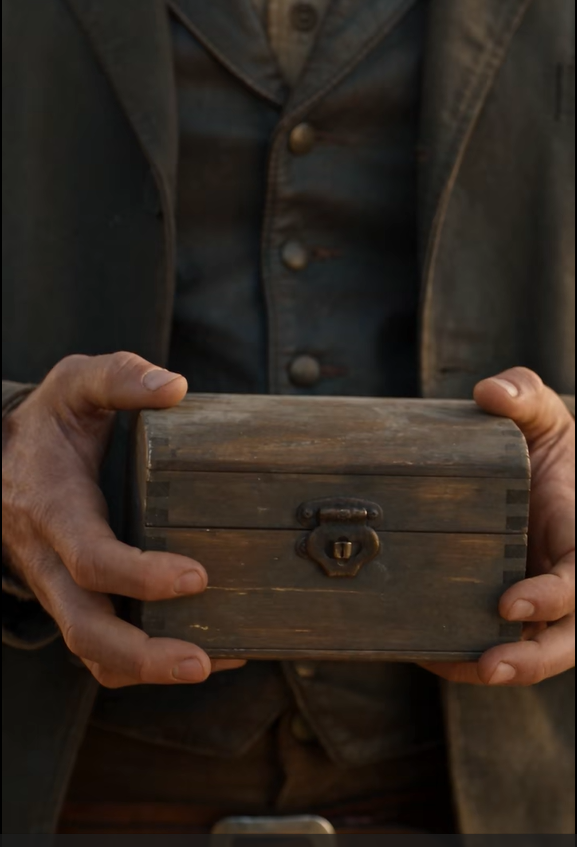
The lock opened with a hard metallic click.
Gideon lifted the lid.
Lydia expected money.
Perhaps a gun.
Maybe letters from a dead sweetheart.
Instead, Gideon reached inside and removed a square of faded linen.
He held it carefully.
Lydia stopped breathing.
A crooked row of blue thread ran across the fabric.
Below it were childish red flowers.
And stitched unevenly at the bottom were words Lydia had not seen in seventeen years.
LYDIA FENWICK — AGE EIGHT.
The cloth slipped from Gideon’s fingers onto the bed.
Lydia screamed.
Not loudly.
It came from somewhere deeper than that.
A broken sound.
“No.”
She scrambled backward until her shoulders struck the cabin wall.
“No.”
“Lydia—”
“Where did you get that?”
Gideon remained near the chest.
“Tell me!”
“My sister gave it to me.”
Lydia stared at him.
“That belonged to my mother.”
“I know.”
Her blood went cold.
“How?”
Gideon inhaled slowly.
“Because my sister died trying to find you.”
Four weeks earlier, Lydia Fenwick had believed the greatest danger in her life was Alton Briggs.
She had been wrong.
Philadelphia had been gray that winter.
Gray streets.
Gray factory walls.
Gray river.
Even the snow turned gray within hours, crushed beneath wagon wheels and mixed with coal ash.
Lydia worked fourteen-hour shifts inside Bellweather Textile Works, where hundreds of looms hammered from sunrise until after dark.
Silk fibers hung permanently in the air.
Women coughed into sleeves.
Girls wrapped bleeding fingers and returned to their machines.
Lydia survived because she was useful.
She could repair a damaged belt.
She could calculate wages faster than the assistant bookkeeper.
She could spot a mistaken shipment number after glancing at a ledger once.
And most importantly, Lydia had learned to make herself invisible.
Then Alton Briggs noticed her.
Briggs was forty-two, carefully dressed, pleasantly spoken, and feared by nearly every woman working the eastern floor.
He began appearing beside Lydia’s station.
“You’ve got fine hands, Miss Fenwick.”
Then:
“A woman with your intelligence shouldn’t spend her entire life beside a loom.”
Then one evening, after the final bell, he cornered her.
His hand flattened against the wall beside her head.
“A woman who wants to keep her position,” he murmured, “should learn to be agreeable.”
Lydia shoved him hard enough that his shoulder struck the loom.
For one extraordinary second, Briggs looked surprised.
Then furious.
“You’ll regret that.”
Lydia believed him.
Three women had already disappeared from Bellweather that year.
Everyone said they had been dismissed.
No one knew where they went.
Three nights later, Lydia found the matrimonial advertisement near the boardinghouse stove.
Wife wanted for respectable homesteader in Idaho Territory. Hardworking. Capable of frontier life. Fare provided. Character valued above beauty.
She laughed when she first read it.
Then she saw Briggs standing outside the boardinghouse the following evening.
Watching the door.
The next morning, Lydia visited matrimonial agent Edmund Crowley.
Crowley occupied two rented rooms above a pharmacy.
He was a thin man nearing sixty, with silver spectacles and perfectly trimmed fingernails.
He smiled constantly.
Too constantly.
Still, he possessed references.
Letters.
Railway receipts.
Even newspaper notices from couples he claimed to have matched successfully.
He showed Lydia a letter from Gideon Rourke.
Thirty-seven.
Widower? No.
Never married.
Livestock owner.
One hundred forty acres near Black Elk Pass.