The second laughed louder.
By the third burst of laughter, the ten-year-old girl had stopped admiring the beautiful red wool and was staring at the cracks between the floorboards, as though she wished the earth beneath Clearwater Mercantile would open and swallow her whole.
“Mercy, Harriet,” Eunice Croft said loudly, “that dress looks like it spent last winter on a scarecrow.”
More laughter followed.
Six feet away, Nellie’s mother stood at the counter with exactly eleven cents remaining in her palm.
Cora Thornton could afford half a sack of oats.
Or a small tin of lard.
She could not afford both.
And dignity, unfortunately, was not something Mr. Higgins sold by the yard.
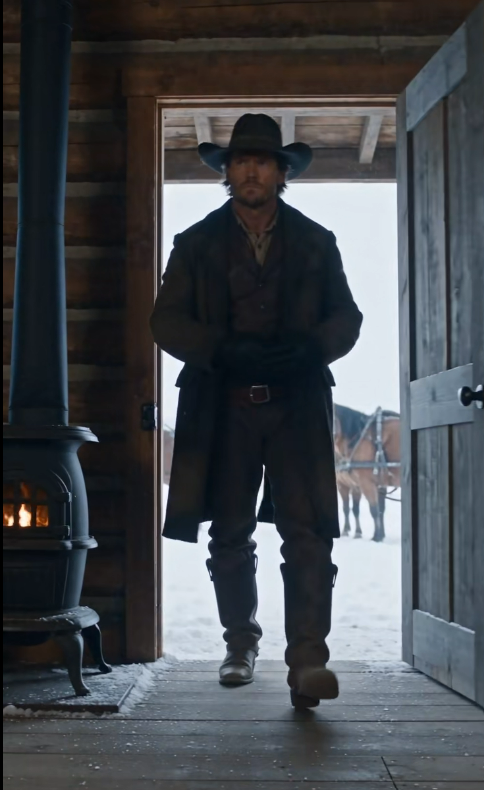
Neither Cora nor her humiliated daughter noticed the tall cowboy standing silently beside the iron stove.
Not until he slowly removed his gloves.
His name was Josiah Langford.
At forty-two, he owned more cattle than most men in Wyoming Territory had dollars. He had survived blizzards, stampedes, rustlers, drought, and men wealthy enough to believe consequences belonged only to other people.
He had also buried a wife and raised a daughter alone.
But it was the sound of a child desperately trying not to cry that made something cold settle behind his eyes.
Josiah said nothing.
Not yet.
Before the next sunrise, however, the women laughing inside that mercantile would discover that the muddy cowboy in the corner was not merely Clearwater’s richest rancher.
And one woman’s husband was about to learn exactly how expensive cruelty could become.
It was November of 1883, and winter had arrived early.
Clearwater sat between a long blue ridge and a river that froze silver around its edges each morning. Railroad surveyors had been working west of town for weeks, and every merchant, banker, rancher, gambler, and landowner seemed obsessed with where the new tracks might run.
Railroads could create fortunes.
They could also destroy towns.
A man who knew where the tracks were going could turn ten dollars of worthless dirt into ten thousand dollars of opportunity.
Cora Thornton knew nothing about railroad fortunes.
She knew her woodpile needed to last until January.
She knew three hens had stopped laying.
She knew the barn roof leaked above the east stall.
And she knew Nellie had grown another inch.
The gray wool dress hanging from her daughter’s narrow shoulders had already been let down twice. It had belonged to another family’s child before reaching Nellie. The elbows were thin, one cuff had been repaired with darker thread, and the collar closed with an iron button because the original bone button had been lost.
But the dress was clean.
Everything Cora owned was clean.
Poverty could enter her home. Neglect could not.
“Half a sack of oats, please, Mr. Higgins,” Cora said.
Edwin Higgins examined the coins.
“And the lard?”
Cora hesitated.
Across the store, Nellie stood near the fabric shelves, hands clasped carefully behind her back.
Her eyes had found a bolt of red wool flannel.
It was breathtaking.
Bright as holly berries against fresh snow.
Nellie leaned closer but did not touch it.
Cora noticed.
“How much is the lard?”
“Seven cents.”
Cora counted again.
“Then just the oats.”
Higgins frowned. “Cora—”
“Just the oats.”
He understood enough not to humiliate her by offering credit.
Then the mercantile door opened.
Cold wind rushed inside with Harriet Gable and Eunice Croft.
Harriet’s husband, Arthur, ran Clearwater Bank and had spent five years making certain everybody knew it. Eunice’s husband owned the grain warehouse and freight yard.
Their coats were trimmed in fur.
Their boots shone.
Blue feathers decorated their expensive hats.
Nellie stepped aside politely.
Harriet noticed the red fabric.
“That red is lovely.”
“Yes, ma’am,” Nellie replied.
“Imported wool.”
Nellie nodded.
“Four dollars a yard,” Eunice added. “Harriet is having a coat made for her niece.”
Nellie immediately pulled her hands farther behind her.
“I wasn’t touching it.”
Harriet slowly looked her over.
The worn sleeves.
The faded hem.
The mismatched button.
“No,” she said. “I imagine not.”
Eunice smiled.
Harriet stroked the red wool.
“It certainly isn’t suitable for farm work.”
“No, ma’am.”
“Although looking at what you’re wearing, I suppose almost anything would be an improvement.”
Eunice laughed.
Nellie froze.
Then Eunice added, loudly enough for everyone nearby to hear, “Honestly, it looks like a flour sack that survived a flood.”
More laughter.
Nellie stared at the floor.
Cora’s face burned.
She could have answered with cruelty of her own.
Instead, she turned toward Higgins.
“My oats, please.”
His jaw tightened as he handed her the sack.
Cora took Nellie’s hand.