“Thomas would have laughed too.”
The silence between them softened.
Josiah knew grief.
Not the polite version people discussed after church.
The real thing.
The kind that changed the shape of a room.
“My wife was named Abigail,” he said.
Cora looked up.
“She died seven years ago.”
“I’m sorry.”
“So am I.”
“What happened?”
“Pneumonia.”
His thumb traced an old scratch in the table.
“Our daughter was fourteen. I kept thinking Abigail would recover because she had recovered from everything else. Childbirth. Fever. A horse kicking her ribs. Living with me.”
Cora smiled faintly.
“When she died, I discovered that confidence has nothing to do with truth.”
Cora understood that too well.
“What did your daughter do?”
“Raised me.”
That pulled another laugh from her.
Josiah smiled.
Then Cora noticed something behind him.
A framed survey map.
She stood.
“Where did you get that?”
Josiah turned.
“The county office.”
Cora walked closer.
The map showed Clearwater and surrounding land.
Her finger followed the river.
Then stopped.
“This is wrong.”
Josiah stood beside her.
“What?”
“The eastern branch.”
“There isn’t one.”
“There was.”
Cora pointed.
“When Thomas and I purchased our farm, there was an old creek bed here. Usually dry. During spring floods it filled.”
“Why does that matter?”
“Thomas said the ridge south of it was solid granite.”
Josiah stared at her.
“Railroads avoid steep grades.”
“I know.”
“But if they followed the creek bed—”
“They could cut through the ridge at its lowest point.”
Cora’s eyes widened.
“And come directly across our south field.”
Josiah said nothing.
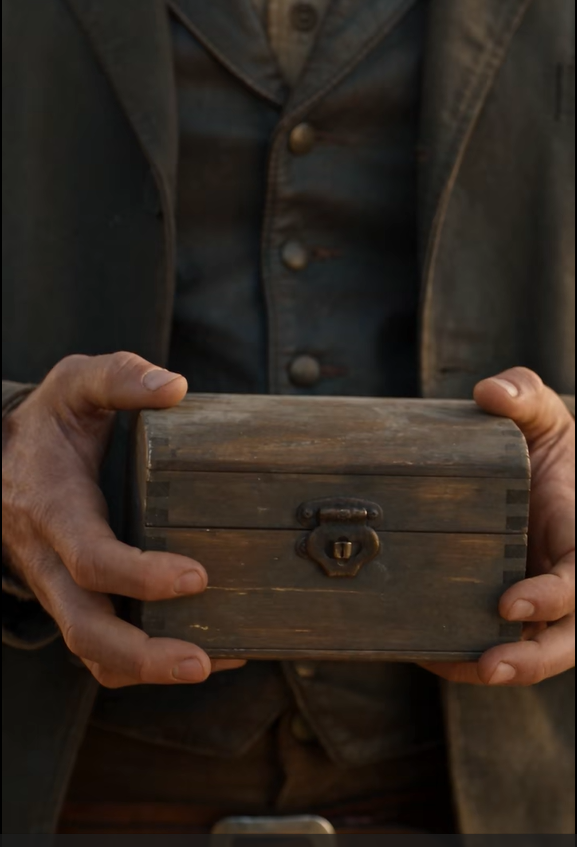
Then both of them remembered the broken chest.
He crossed the room.
“Your husband found the route.”
Cora’s mouth went dry.
“But why hide it?”
“Because land speculation around railroads can turn respectable men into wolves.”
Josiah grabbed his coat.
“We’re going to your farm.”
“Now?”
“Now.”
They reached the Thornton property shortly before sunset.
Nellie had stayed with Mrs. Higgins.
Cora unlocked the house.
They searched Thomas’s desk.
Nothing.
Bedroom.
Nothing.
Kitchen.
Nothing.
Barn.
Nothing.
After two hours, Cora stood exhausted beside Thomas’s old survey chest.
“He took the real map with him.”
“Maybe.”
“Then whoever searched this place wasted their time.”
Josiah stared at the chest.
Something bothered him.
The broken lock.
The scattered papers.
Too obvious.
Thomas had been cautious.
A man cautious enough to warn his wife about Arthur Gable would never hide the most important map inside a chest labeled with surveying instruments.
Josiah turned.
“What did your husband care about most?”
Cora frowned.
“Nellie.”
“What else?”
“Land. Books. His compass.”
“Anything he built himself?”
Cora looked toward the house.
Then froze.
“The floor.”
“What?”
“He replaced the kitchen floor two weeks before he died.”
They ran inside.
The kitchen boards appeared ordinary.
Josiah knelt.
One plank near the stove was slightly narrower.
He pushed.
Nothing.
Cora stared.
Then remembered.
Thomas had once scolded Nellie for spilling milk near the hearth.
Not because of the milk.
Because she had pried at a loose nail.
Cora grabbed the iron poker.
Josiah worked the board free.
Beneath it sat a narrow metal box wrapped in oilcloth.
Neither spoke.
Cora lifted it.
Inside were three things.
A railroad survey map.
A sealed envelope.
And a small leather ledger.
Cora’s hands shook.
The envelope read:
CORA — IF I DO NOT RETURN
She almost dropped it.
Josiah stepped away.
“You should read that alone.”
“No.”
Her voice cracked.
“If this involves the railroad, stay.”
She opened the letter.
Thomas’s handwriting filled four pages.
My dearest Cora,
If you are reading this, then something I feared has happened.
I discovered the Western Continental’s preferred corridor three months ago. The route does not run north of Clearwater as Arthur Gable has been telling people. It runs south, across our land, then east along the old creek bed.
Arthur learned enough to understand what my survey meant.
He offered me $800 for our property.
I refused.
He offered $2,000.
I refused again.
Then he threatened me.
Cora covered her mouth.
Josiah read silently beside her.
Thomas continued.
I began looking into Arthur’s land purchases. He has been using depositors’ money through false intermediary loans to buy northern acreage, believing he could force the railroad toward his investments or sell them before the truth became public.
But there is more.
The railroad cannot legally build through the southern corridor without water access.
And the only year-round spring along the proposed section lies beneath our property.
Cora looked at Josiah.
“Our spring?”
He nodded grimly.
She kept reading.
I purchased the underground water rights separately when we acquired the farm.
Cora, those rights are worth more than the house, fields, livestock, and perhaps every business in Clearwater combined.