The window was broken.
Cora’s stomach tightened.
She rushed inside.
Nothing seemed stolen.
The saddle remained.
Tools.
Feed.
An old wagon tongue.
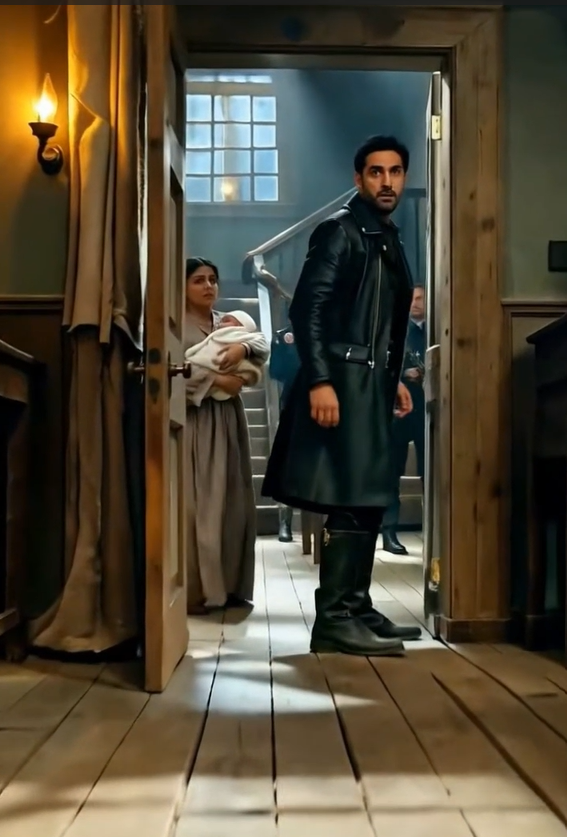
Then she noticed the loft ladder.
Moved.
Josiah climbed it before she could stop him.
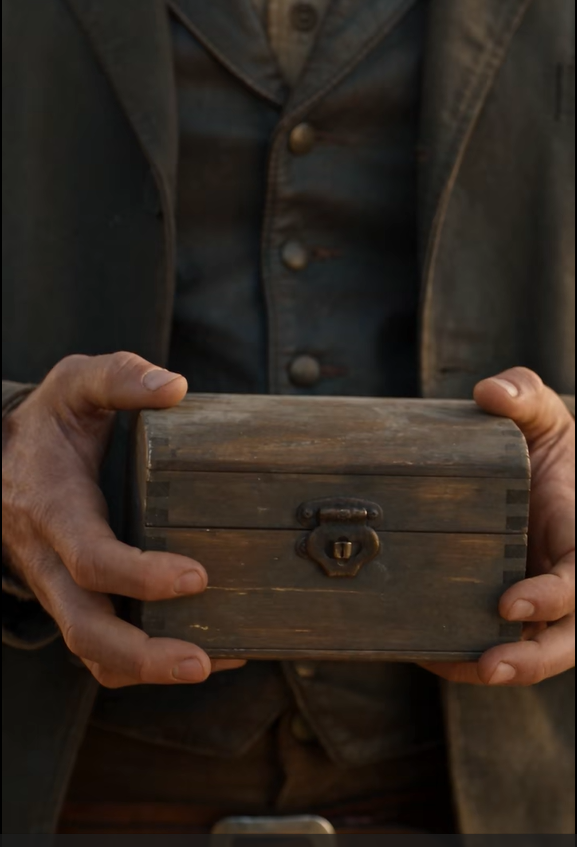
The loft contained hay, old crates, Thomas’s surveying chest—
Cora froze.
The chest was open.
Someone had forced the lock.
She climbed after Josiah.
Papers covered the floor.
Old maps.
Tax receipts.
Boundary sketches.
Thomas’s notebooks.
Josiah picked one up.
“Who knew these were here?”
“No one.”
“Your husband was a surveyor?”
“Sometimes. Mostly land boundaries.”
“Railroad work?”
Cora hesitated.
“A little.”
Josiah slowly turned.
“Mrs. Thornton, when did your husband die?”
“Eighteen months ago.”
His face became unreadable.
“Where?”
“Northern freight road.”
“Wagon accident?”
“Yes.”
Josiah stared at the scattered maps.
Then he said something that made the cold loft seem colder.
“Thomas Thornton wasn’t surveying farm boundaries before he died.”
Cora’s pulse quickened.
“How would you know?”
“Because eighteen months ago, the Western Continental Railroad hired three confidential scouts to identify possible routes through Clearwater.”
He picked up a torn scrap of parchment.
A small symbol had been drawn in one corner.
A circle crossed by two parallel lines.
“The railroad uses this mark on private preliminary surveys.”
Cora stared.
“What are you saying?”
“I’m saying your husband knew where the tracks were supposed to go.”
Outside, a dog barked somewhere far down the road.
Josiah looked toward the broken window.
“And somebody thinks the answer is still in this barn.”
By eight the next morning, Arthur Gable knew Josiah had paid for the red wool.
By nine, he knew Josiah had visited the Thornton property.
By ten, he was furious.
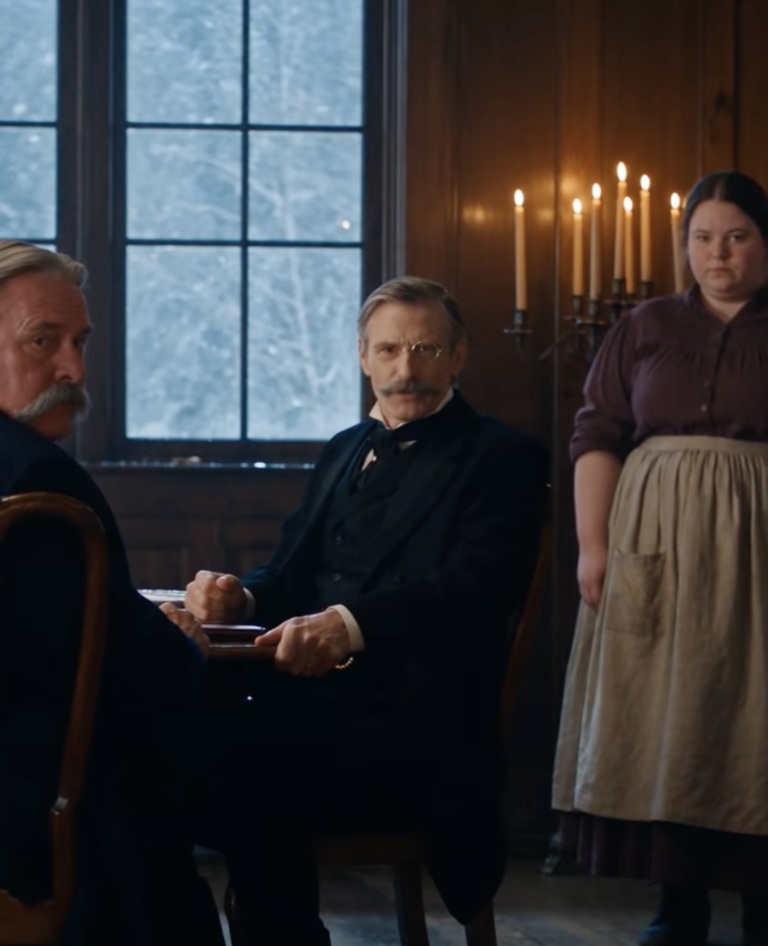
Arthur Gable was fifty-one, handsome in the polished way of men who spent more time behind desks than fences. His suits came from Chicago. His mustache was trimmed daily. His boots rarely touched mud.
His bank occupied the finest brick building in Clearwater.
He had made certain of that.
Harriet stood in his office.
“You should have heard how he spoke to me.”
Arthur barely listened.
“He went to the Thornton place?”
“Yes.”
“With Higgins.”
“How long?”
“I don’t know.”
Arthur rose so quickly his chair struck the wall.
Harriet stared.
“Arthur?”
“Did Langford ask about Thomas?”
“No.”
“Maps?”
Her anger faded.
“What maps?”
Arthur grabbed his coat.
“Go home.”
“Why?”
“Go home, Harriet.”
She recoiled.
“You cannot speak to me like—”
“GO.”
Harriet left.
Arthur waited until the door closed.
Then he unlocked the lowest drawer of his desk.
Inside lay a fragment of an old survey map.
A red line crossed the western edge of Clearwater.
It did not pass through Arthur’s land.
It did not pass through Eunice Croft’s husband’s warehouse.
It curved south.
Straight through the Thornton farm.
Arthur stared at it.
Eighteen months earlier, he had possessed only this fragment.
Thomas had possessed the rest.
And Thomas had refused to sell.
Arthur had spent the next year quietly buying property north of town while publicly convincing investors that the railroad would run there.
Dozens had followed him.
Merchants mortgaged stores.
Farmers sold southern acreage cheaply.
Arthur extended loans secured against northern parcels.
If the railroad went north, everyone became wealthy.
Especially Arthur.
But if Thomas’s survey was correct—
Arthur could lose everything.
A knock sounded.
Sheriff Wallace entered.
“You wanted me?”
Arthur folded the map.
“I want eyes on Langford.”
Wallace frowned.
“That man has a reputation.”
“So do you.”
Silence.
Arthur opened another drawer.
Money appeared.
Wallace stared at it.
Arthur pushed the bills across the desk.
“Find out what he knows.”
At Langford Ranch, Cora discovered that Josiah had not lied about his bookkeeping.
It was atrocious.
Receipts sat inside coffee tins.
Invoices were stuffed between cattle ledgers.
A bill from March had been used to level a table leg.
Cora spent three hours organizing paper while Josiah sat opposite her pretending not to watch.
Finally she held up a receipt.
“Four hundred pounds of fencing wire.”
“Yes.”
“Where?”
“North pasture.”
“You paid twice.”
Josiah frowned.
“No.”
Cora showed him two invoices.
He stared.
“Well.”
“You have been robbed.”
“Apparently.”
“Repeatedly.”
“That explains why Wilkes bought that new saddle.”
Cora laughed before she could stop herself.
Josiah looked at her.
The laughter faded.
“What?”
“Nothing.”
“You’re staring.”
“I haven’t heard you laugh.”
Cora looked back at the papers.
“You barely know me.”
“Still haven’t heard it.”
She continued writing.
“My husband used to say my laugh scared birds.”
“Smart man.”
Her hand stopped.
Josiah immediately regretted the joke.
“I’m sorry.”
“No.”
She looked toward the window.