A large log house stood near the center.
Behind it sat a barn, smokehouse, workshop, chicken shed, root cellar, and two smaller cabins.
A frozen creek cut through the property.
Fences disappeared beneath snow.
Three horses moved inside a sheltered corral.
Thomas forgot his fear long enough to stare.
“This is yours?”
Caleb nodded.
“Most of it.”
Eleanor frowned.
“Most?”
“The bank owns the parts it hasn’t figured out how to steal yet.”
That was the first joke she heard him make.
She wasn’t entirely certain it was a joke.
Inside, the house surprised her even more.
It was clean.
Not perfectly.
But unmistakably cared for.
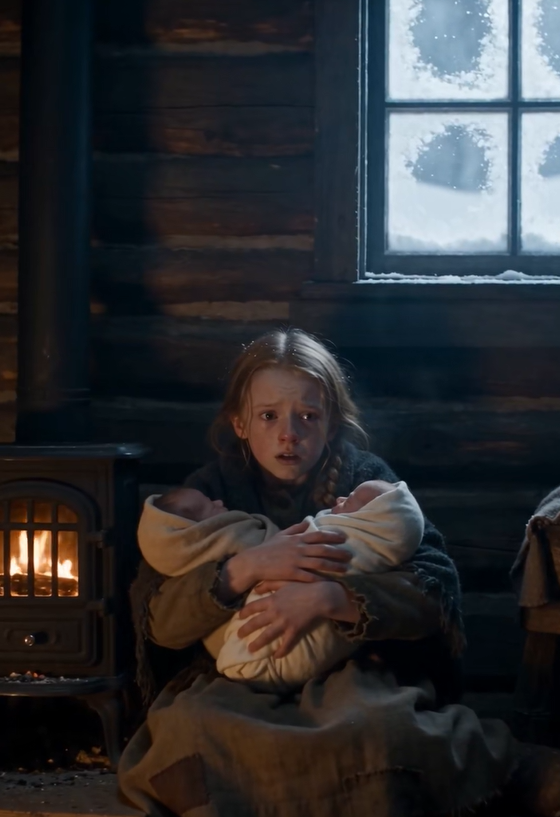
A massive stone fireplace occupied one wall.
Shelves were filled with preserved food.
Bundles of herbs hung near the kitchen.
There were books.
Dozens of them.
Perhaps hundreds.
Sarah immediately noticed.
“You read?”
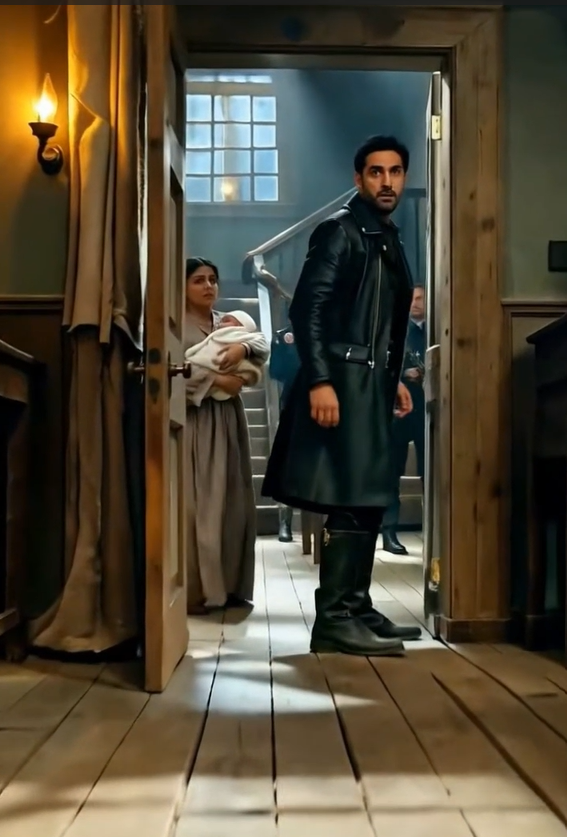
Caleb removed his coat.
“Occasionally.”
Sarah pulled a battered copy of The Last of the Mohicans from a shelf.
“All these are yours?”
“They don’t belong to the chickens.”
Sarah smiled before catching herself.
Caleb almost smiled too.
Then Eleanor noticed something stranger.
Eight wooden bowls sat stacked beside the stove.
Eight spoons.
Eight tin cups.
She counted again.
Eight.
Caleb lived alone.
Why did a solitary mountain man own tableware for eight people?
Her unease returned.
That evening, Caleb showed them the house.
The younger children would sleep together upstairs.
Sarah had a small room of her own.
Thomas and James would share another.
William would sleep in the loft until spring.
Eleanor stopped at the final bedroom.
“And where do I sleep?”
Caleb nodded toward it.
“Here.”
“And you?”
“Cabin near the barn.”
She stared.
“You aren’t sleeping in the house?”
“No.”
“But we’re married by territorial contract.”
“We signed an agreement.”
“The agreement calls you my husband.”
Caleb’s expression hardened slightly.
“The agreement kept seven children from being scattered across Wyoming.”
Eleanor said nothing.
He continued.
“What happens beyond that will be your decision.”
For several seconds she could not speak.
Men had controlled nearly every important decision since her husband died.
Factory supervisors.
Landlords.
Debt collectors.
Government clerks.
The Bride Society.
The auction master.
And now the one man who possessed the legal power to demand the most from her was giving it back.
“Your room has a lock,” Caleb said. “Only key is inside.”
Then he walked away.
That night Eleanor locked the door anyway.
The first month transformed them.
Not gently.
Not easily.
But steadily.
Caleb woke before sunrise.
So did Eleanor.
She organized the pantry, counted supplies, repaired clothing, baked bread, taught Margaret and Catherine their letters, and quickly discovered Caleb’s household had one serious flaw.
He possessed enough provisions to survive winter.
But he had no idea where anything was.
“Why are there nails beside the coffee?”
“They fit there.”
“They do not.”
“They’ve been there six years.”
“Then they’ve been wrong for six years.”
Caleb stared at her.
Eleanor moved the nails.
He never moved them back.
Thomas and James helped in the barn.
William fed chickens.
Sarah became fascinated with Caleb’s books.
Caleb taught her mathematics after discovering she could multiply faster than he could.
Little Edward followed him everywhere.
At first Caleb seemed uncomfortable with the boy.
Edward did not care.