Three-year-olds rarely respected emotional boundaries.
One morning Eleanor found Caleb splitting wood while Edward stood beside him holding a twig.
“What are you doing?” she asked.
Edward proudly answered.
“Helping Mr. Roar.”
Caleb swung the axe.
“He’s terrible at it.”
“I am not!”
“You’ve been working twenty minutes and haven’t split one log.”
Edward looked offended.
“I’m little.”
Caleb stopped.
He considered this.
“Fair argument.”
By February, Edward called him Caleb.
By March, he sometimes called him “Bear.”
Nobody knew why.
Caleb pretended to hate it.
Eleanor knew better.
Yet something remained wrong.
Several times she noticed riders on distant ridges.
Watching.
Caleb noticed them too.
Whenever it happened, his entire manner changed.
His shoulders tightened.
His gaze became colder.
And his rifle remained closer afterward.
One evening Eleanor confronted him.
“Who are they?”
Caleb continued cleaning the rifle.
“Travelers.”
“Travelers don’t sit on a ridge for two hours watching someone’s house.”
He looked up.
“No.”
“Then who?”
“Men looking for something.”
“What?”
Caleb’s jaw tightened.
“I don’t know yet.”
“Are they looking for you?”
“Probably.”
“Why?”
He returned to the rifle.
“Because people have been looking for me most of my life.”
That answer ended nothing.
The trouble began in April.
Snowmelt turned the creek into a roaring brown ribbon.
The children were collecting branches near the barn when Thomas shouted.
A rider had appeared at the southern fence.
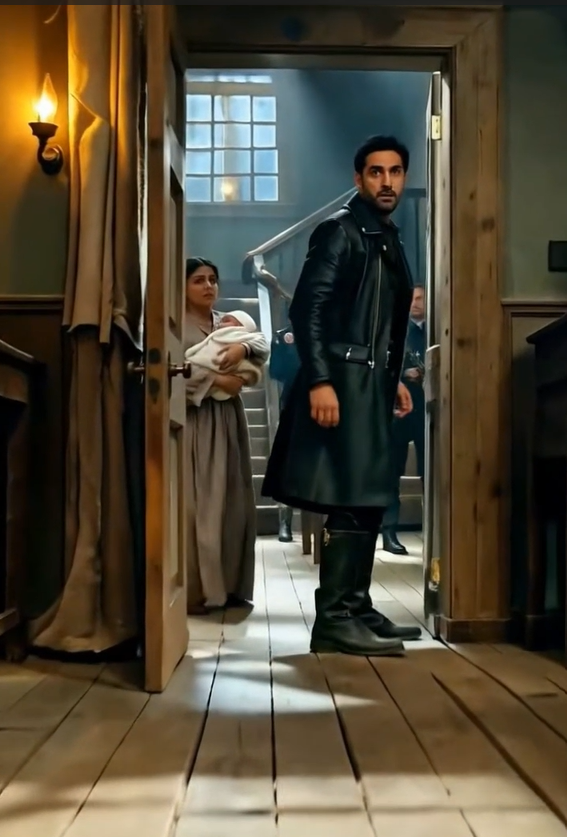
The man wore a dark coat and city boots unsuitable for mountain mud.
Caleb walked toward him alone.
Eleanor watched from the porch.
The rider smiled.
“Roar.”
Caleb did not.
“Mercer.”
The name struck Eleanor strangely.
She had heard it somewhere.
The rider glanced toward the house.
“So it’s true.”
Caleb stepped between him and the porch.
“Leave.”
Mercer smiled wider.
“You always did collect strays.”
Caleb’s hand moved toward his gun.
Mercer noticed.
“So touchy.”
Then his gaze found Eleanor.
“Mrs. Hayes, I presume?”
Caleb’s voice dropped.
“Don’t speak to her.”
Mercer ignored him.
“Did he tell you?”
Eleanor felt the blood drain from her face.
“Tell me what?”
Caleb stepped forward.
Mercer laughed.
“Oh, this is better than I imagined.”
“What is he talking about?” Eleanor demanded.
Caleb said nothing.
Mercer tipped his hat.
“You might ask your husband why he was in Philadelphia eighteen months ago.”
Eleanor stopped breathing.
Philadelphia.
Caleb stared at Mercer with such fury that even from the porch Eleanor felt it.
“Ride.”
Mercer’s horse turned.
Before leaving, he called back.
“Ask him about Daniel Hayes!”
The world seemed to tilt.
Eleanor’s dead husband’s name echoed across the valley.
Daniel Hayes.
Caleb remained motionless beside the fence.
Eleanor descended the porch steps.
“What did he mean?”
Caleb looked toward the children.
“Inside.”
“No.”
“Eleanor.”
“What did he mean?”
His face changed.
For the first time since she had met him, Caleb Roar looked afraid.
Not of Mercer.
Of her.
“Inside,” he repeated quietly. “And I’ll tell you.”
They sat at the kitchen table.
Sarah took the younger children upstairs.
Thomas refused.
“I’m staying.”
Eleanor almost ordered him away.
Then decided he had earned the truth too.
Caleb remained standing.
“Your husband wasn’t killed in an accident.”
Eleanor felt something inside her go still.
“The mine collapsed.”
“No.”
“Officials told me—”
“They lied.”
She rose.