Three Hundred Warriors Came for the Man Who Gave Her Water. By Sunset, Corvin Torne Learned Why His Own Name Had Been Waiting Beneath the Buffalo Hide.
The buffalo hide came away, and Corvin Torne forgot how to breathe.
There was no gold beneath it.
No rifle.
No ceremonial offering.
There was a coffin.
It had been made hastily from rough cedar boards, the seams bound with rawhide instead of nails. Dust clung to the wood. One corner had been darkened by dried blood.
And burned into the lid were two words Corvin had not seen written together in twenty-three years.
ELIAS TORNE.
His father’s name.
Corvin stumbled backward.
The yard tilted beneath him.
“No,” he whispered.
He had been seven years old when Elias Torne disappeared.
For twenty-three years, Corvin had believed exactly what every settler between Fort Grant and the northern foothills had told him.
His father had ridden east with two horses and a wagonload of hides.
He had never returned.
Weeks later, a broken saddle and Elias’s bloodstained coat had been found near Apache country.
No body.
No grave.
Just enough evidence for men in town to say the obvious thing.
The Apaches killed him.
Corvin had grown up with those words.
He had heard them whispered in church.
Spoken over whiskey.
Used as justification for every burned camp, every revenge patrol, every frightened settler reaching instinctively for a rifle.
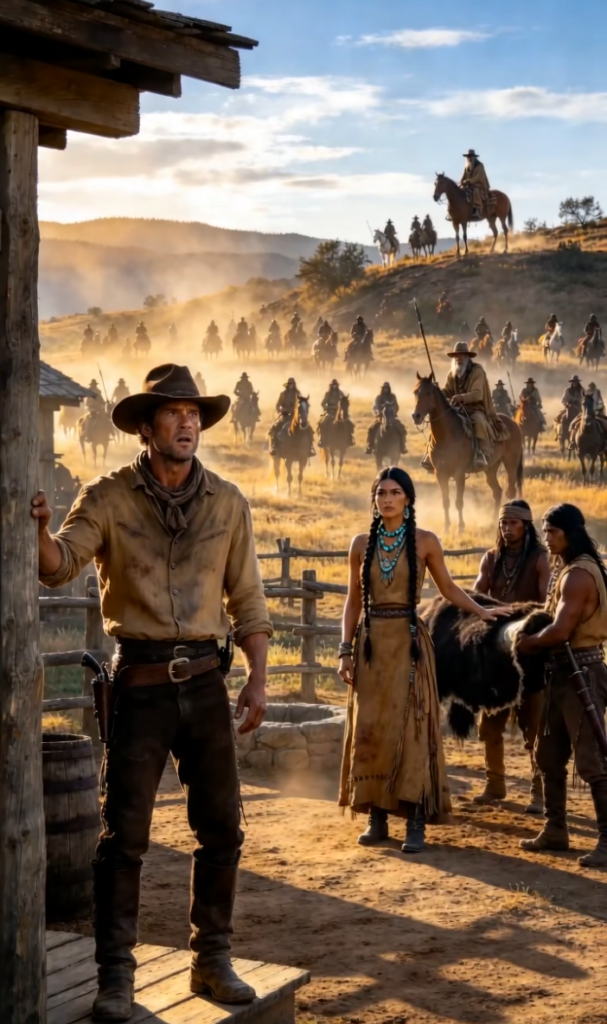
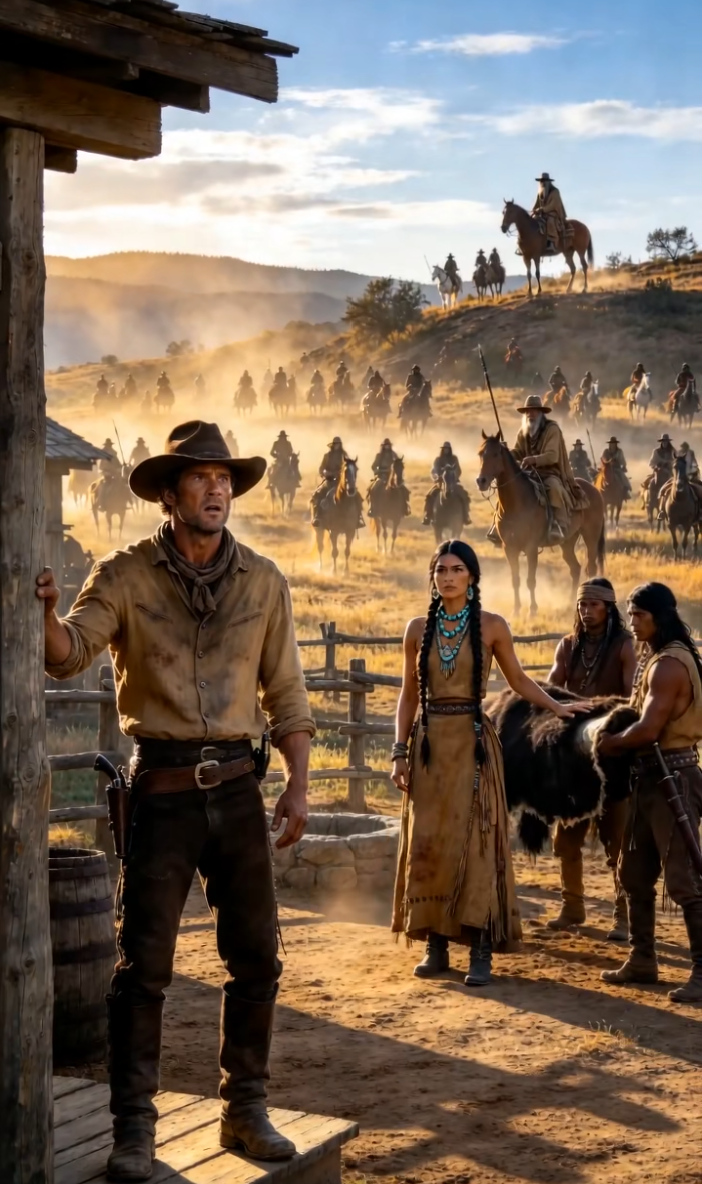
And now three hundred Apache warriors had carried Elias Torne’s coffin home.
Corvin looked at the enormous woman.
“What is this?”
Her gaze did not leave his.
“Your father.”
“My father has been dead twenty-three years.”
“No.”
One word.
Calm.
Certain.
Corvin’s hand curled into a fist.
“You expect me to believe—”
“He died three nights ago.”
Something cracked inside Corvin.
Not loudly.
Not dramatically.
It simply gave way.
He stared again at the coffin.
The older warrior remained motionless several yards away. Across the ridges, hundreds of mounted figures waited in perfect silence.
Corvin’s voice emerged rough.
“Where?”
The woman answered.
“North of Black Mesa.”
“How?”
“A bullet.”
“Whose?”
For the first time, something changed in her face.
Anger.
“That is why we came.”
Corvin moved toward the coffin.
Two warriors shifted instinctively.
The woman lifted one hand.
They stopped.
Corvin knelt.
His fingers touched the cedar.
He expected cold wood.
Instead, his hand trembled so badly his fingernails scraped the grain.
“Open it.”
The woman’s expression tightened.
“You may not want—”
“Open it.”
She studied him, then nodded.
One of the warriors loosened the rawhide binding.
Corvin raised the lid.
Age had changed Elias Torne brutally.
The broad black beard Corvin remembered was almost entirely white. Deep lines crossed his forehead. A scar ran from one temple to his jaw.
But the nose was the same.
So were the heavy eyebrows.
And around the dead man’s neck hung a small brass compass Corvin recognized immediately.
He had played with it as a child.
His father used to tap the glass and say, A man who knows where he stands can usually find his way home.
Corvin reached inside.
His fingers closed around the compass.
Elias Torne had not been murdered twenty-three years ago.
He had been alive.
Somewhere.
All this time.
A terrible pressure built behind Corvin’s ribs.
“Why didn’t he come home?”
The enormous woman looked toward the well.
“He tried.”
“When?”
“Many times.”
Corvin stood sharply.
“Then where was he?”
“With us.”
Every muscle in Corvin’s body tightened.
“With you?”
“Yes.”
“You kept him prisoner?”
“No.”
“Then why?”
The woman stepped closer.
Despite her size, there was no threat in the movement.
Only exhaustion.
And something Corvin still could not understand.
“He stayed because returning would have killed you.”
Corvin laughed once.
It was an ugly sound.
“You ride onto my land with three hundred armed men, put my father in a box, and tell me he abandoned me to save me?”