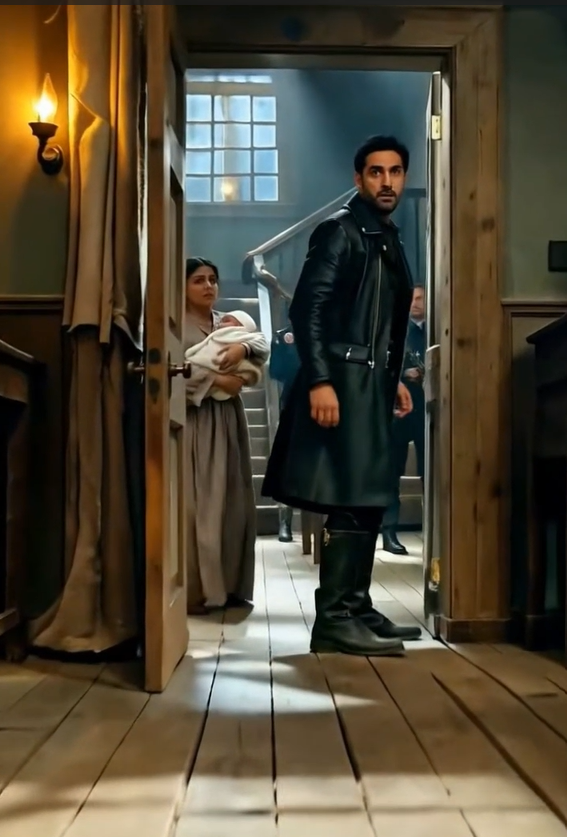

The first time Eleanor Ward struck the master of Blackthorn Hall, thirty-two people heard the sound—and not one of them breathed afterward.
His head snapped sideways.
A silver tray slipped from somebody’s hands and crashed against the marble floor.
In the doorway, the cook covered her mouth.
The footmen froze.
Even the grandfather clock seemed suddenly too loud.
Eleanor stood in the center of the drawing room with one hand still raised.
For four years, she had lowered that hand when others ordered her about.
Folded it behind her back while guests criticized dust that did not exist.
Used it to scrub fireplaces, carry breakfast trays, polish silver, mend torn cuffs, empty ash pans, and close doors quietly after rich people finished saying cruel things about servants they assumed could not hear.
Four years of obedience.
Four years of silence.
Four years of being
“the quiet maid.”
And now Adrian Blackwood, owner of the house, was staring at her as though a chair had slapped him.
“You—”
His voice shook.
Not from pain.
From disbelief.
Nobody struck Adrian Blackwood.
Nobody contradicted him.
Nobody at Blackthorn Hall forgot their place.
Eleanor slowly lowered her hand.
“You will not touch me again.”
Adrian’s face darkened.
A red mark bloomed across his left cheek.
“You insolent little—”
He lunged.
Eleanor moved before he finished.
She caught his wrist, turned beneath his arm, and drove him forward against the edge of the writing desk.
The room gasped as one.
Adrian shouted.
“What the devil—”
Eleanor twisted harder.
He dropped to one knee.
Mrs.
Fenwick, the housekeeper, whispered:
“My God.”
Eleanor was not large.
She was twenty-nine, narrow-waisted, dark-haired, and so ordinary in her gray uniform that guests often asked her name three or four times during the same visit.
But her father had taught her one useful thing before disappearing from her life.
Strength mattered less than leverage.
And Adrian Blackwood had made the mistake of assuming silence meant weakness.
“Let go of me!” he shouted.
“Promise you will keep your hands to yourself.”
“You’re dismissed!”
“That was not what I asked.”
His face twisted.
“I’ll have you arrested.”
“For what?”
“Assault!”
Eleanor leaned closer.
“For stopping you from striking a servant in front of thirty witnesses?”
Several servants suddenly became fascinated with the floor.
Adrian’s fury sharpened.
“You think any one of them will speak for you?”
That was the ugliest part.
Perhaps he was right.
Blackthorn Hall employed people whose families depended upon every shilling.
The cook had a sick husband.
Thomas the footman supported two sisters.
Mrs.
Fenwick’s son was at university because wages from Blackthorn helped pay his fees.
Adrian understood hunger better than any starving man.
He understood how useful it was when it belonged to someone else.
Eleanor released him.
Adrian surged upright.
His hand swept across the desk—
and something flew from his waistcoat pocket.
A small object struck the floor.
Clink.
It rolled across the polished boards.
Once.
Twice.
Then stopped against Eleanor’s shoe.
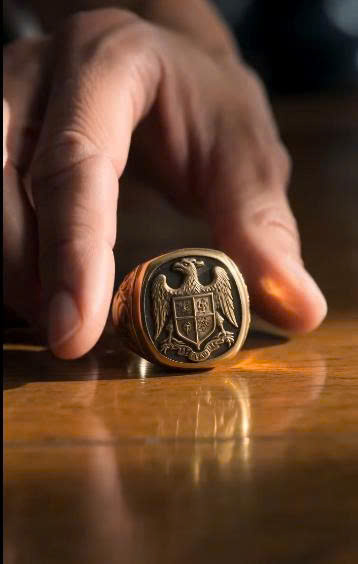
A ring.
Heavy gold.
A dark green stone surrounded by a circle of tiny black diamonds.
Nobody else reacted.
Eleanor did.
All color left her face.
Adrian saw it.
And for the first time since she had known him,