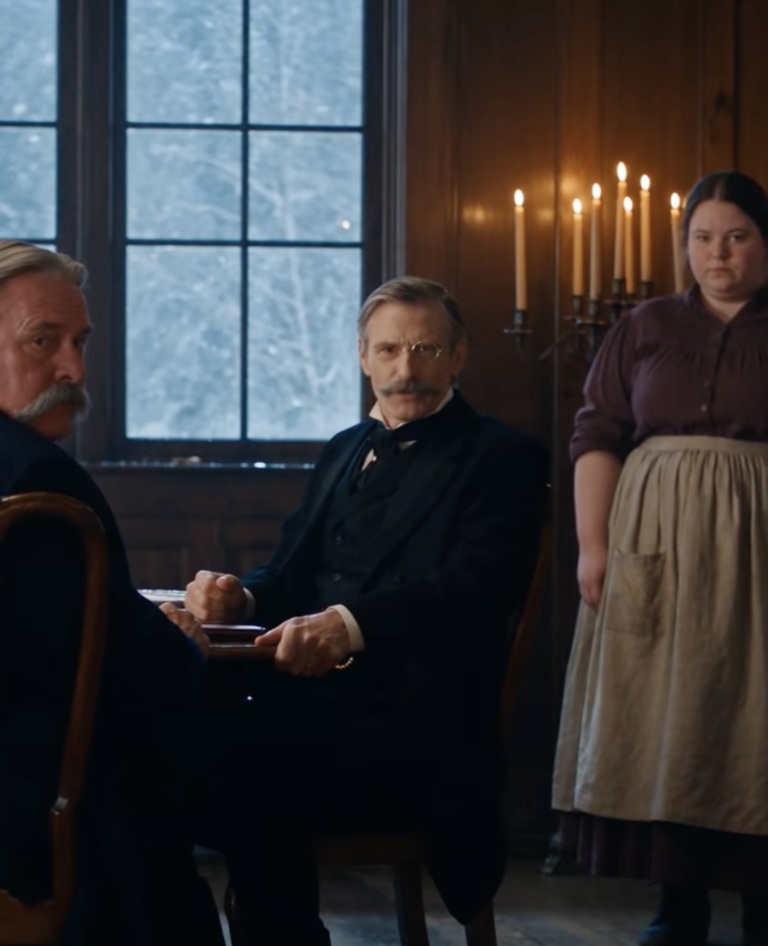
fear replaced arrogance in his eyes.
Eleanor bent slowly.
Picked up the ring.
Turned it between her fingers.
Beneath the setting, almost invisible from years of wear, were three tiny scratches.
One long.
Two short.
Her heartbeat stopped.
She knew those marks.
She had made them herself when she was thirteen years old.
With her father’s engraving needle.
Eleanor looked at Adrian.
“Where did you get this?”
He held out his hand.
“Give it back.”
Her fingers closed around the ring.
“Where did you get it?”
“Now.”
“Answer me.”
Something moved through the watching servants.
They had never heard her use that voice.
Neither, apparently, had Adrian.
He stepped closer.
“That belongs to my family.”
Eleanor almost laughed.
“No.”
His jaw tightened.
“You know nothing about my family.”
She looked down at the ring.
Then back at him.
“This belonged to my father.”
And in that instant, the room changed.
Because everyone in Blackthorn Hall knew the story of Eleanor Ward’s father.
At least they thought they did.
His name had been Nathaniel Ward.
Accountant.
Forger.
Thief.
A man accused nineteen years earlier of stealing nearly forty thousand pounds from the Blackwood estate before vanishing into the night.
The scandal had destroyed his wife.
Ruined his name.
And left his ten-year-old daughter to spend much of her childhood being introduced as
the thief’s girl.
Adrian Blackwood’s voice became very soft.
“You are mistaken.”
Eleanor stared into his eyes.
“No.”
She opened her palm.
“My father wore this ring every day until the night he disappeared.”
Adrian’s face had become almost white.
Eleanor continued.
“And you just dropped it from your pocket.”
Four years earlier, when Eleanor first arrived at Blackthorn Hall, nobody recognized her.
Why would they?
The scandal of Nathaniel Ward belonged to another generation.
Lord Edmund Blackwood had been alive then.
His son Adrian had been only seventeen.
Eleanor had been a child with two braids and a face softened by baby fat.
Now she wore a maid’s cap and used her mother’s maiden name.
She had not come to Blackthorn Hall by accident.
That was the first secret.
For nineteen years Eleanor had lived with one question:
Why had her father abandoned her?
The official answer was money.
Nathaniel Ward, trusted accountant to Lord Edmund Blackwood, allegedly falsified estate ledgers and transferred £38,000 into hidden accounts.
When the theft was discovered, Nathaniel vanished.
So did the money.
Police found his horse two villages away.
His coat near the river.
No body.
Lord Edmund told everyone Nathaniel had fled abroad.
The newspapers accepted it.
Eleanor’s mother did not.
“He was frightened,” Catherine Ward had told her daughter before dying of fever three years later.
“Not guilty.
Frightened.”
“Of what?”
Catherine never answered.
Maybe she did not know.
But shortly before Eleanor turned twenty-five, a parcel arrived.
No return address.
Inside was a page torn from an old Blackwood estate ledger.
One sentence had been written across the back.
YOUR FATHER DID NOT STEAL FROM BLACKTHORN.
HE FOUND WHAT BLACKTHORN STOLE.
That was why Eleanor became a maid.
Not because she lacked education.
Nathaniel Ward had taught his daughter numbers, shorthand, bookkeeping, French, and enough Latin to impress a curate.
But educated women without references did not walk freely into aristocratic private studies.