Rowan nearly dropped the paper.
Eight dollars.
That was more than a ranch hand earned in a week.
And geese shed.
They did not need to be killed.
She could harvest naturally molted down season after season.
Suddenly, the worthless eggs represented something extraordinary.
A flock.
A livelihood.
Perhaps even a fortune.
Word spread.
So did Voss’s anger.
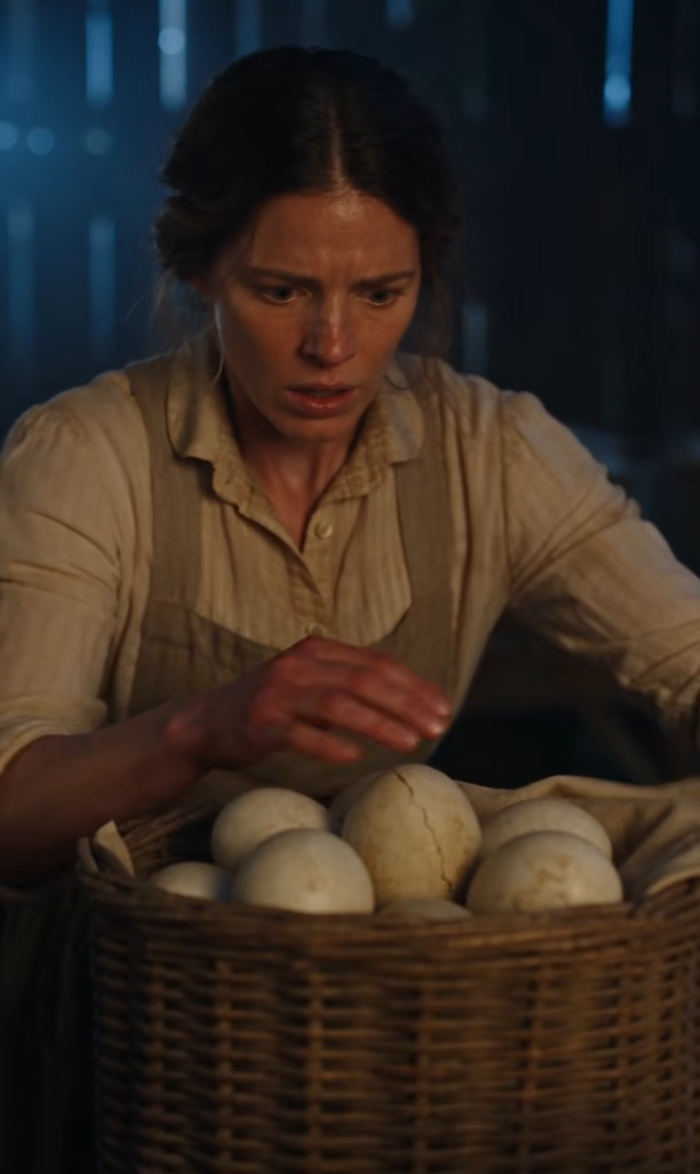
In February, Rowan received an unexpected visitor.
A woman named Dr. Miriam Vale arrived by train from St. Louis.
She was forty, sharp-eyed, and carried a leather case full of breeding records.
“I’m looking for Hawthorne stock.”
Rowan’s blood cooled.
“How did you hear?”
“A feather broker forwarded your sample.”
Miriam inspected the geese and immediately became still.
“These aren’t ordinary Hawthornes.”
“What are they?”
Miriam lifted one bird gently.
“They’re Mercer-Voss wetlands.”
Rowan stared.
“Mercer?”
“Your uncle bred the original line.”
The barn seemed to tilt.
“My uncle?”
Miriam nodded.
“Silas Mercer and Elias Voss were partners once.”
Rowan remembered the notebook.
Unusual birds. Dangerous men. Refused their offer.
“What happened?”
Miriam looked uncomfortable.
“Silas developed a strain that could live on marsh forage and produce unusually dense down. Voss supplied financing and transportation. Hawthorne supplied breeding stock.”
“So why has nobody heard of them?”
“Because the program ended after a fire.”
Rowan’s pulse quickened.
“What fire?”
Miriam looked directly at her.
“A breeding barn burned in 1885. Nearly four hundred birds died.”
“And my uncle?”
“He left the company afterward.”
“Why?”
“I don’t know.”
Miriam hesitated.
“There was another problem.”
“What?”
“The ownership records disappeared in the fire.”
Rowan slowly sank onto a stool.
“Meaning?”
“Meaning whoever possessed surviving breeding stock could potentially claim the line.”
Rowan looked toward the geese.
“Voss dumped them.”
Miriam shook her head.
“No breeder dumps stock like this.”
The truth landed between them.
The eggs had not been discarded because they were worthless. Someone had been trying to destroy them.
That night Rowan opened every one of Silas’s notebooks.
Near dawn, she found a hidden compartment inside his old writing desk.
There was a packet wrapped in oilcloth.
Inside lay correspondence between Silas and Hawthorne Breeding Company.
One letter made Rowan stop breathing.
Mr. Mercer, we acknowledge your sole development rights to Marshline Strain Seven, pending settlement with investor Elias Voss. Your breeding records demonstrate that the defining cross was completed prior to Mr. Voss’s financial involvement.
Another document contained hand-drawn diagrams of The Sink.
Not crops.
Water channels.
Nesting islands.
Drainage ponds.
Her uncle had not failed to farm the land.
He had designed it.
Every low trench.
Every flooded depression.
Every stand of reeds Rowan thought wild.
It was intentional.
The Sink was not broken land.
It was a breeding farm.
At the bottom of the packet lay one final note.
Rowan recognized Silas’s handwriting.
If the line ever returns, the land belongs to it. Do not trust Voss. He did not burn the first barn for money. He burned it because he discovered what the birds were carrying.
Rowan read the sentence three times.
What the birds were carrying?
She marched to Miriam’s room.
“What does this mean?”
The scientist read the note.
Her face paled.
“I have an idea.”
She opened her case.
For the next two days, Miriam examined feathers, droppings, eggshell remnants, and blood from several birds.
Rowan waited impatiently.
Finally, Miriam emerged.
“I think your uncle was breeding disease resistance.”
Rowan frowned.